



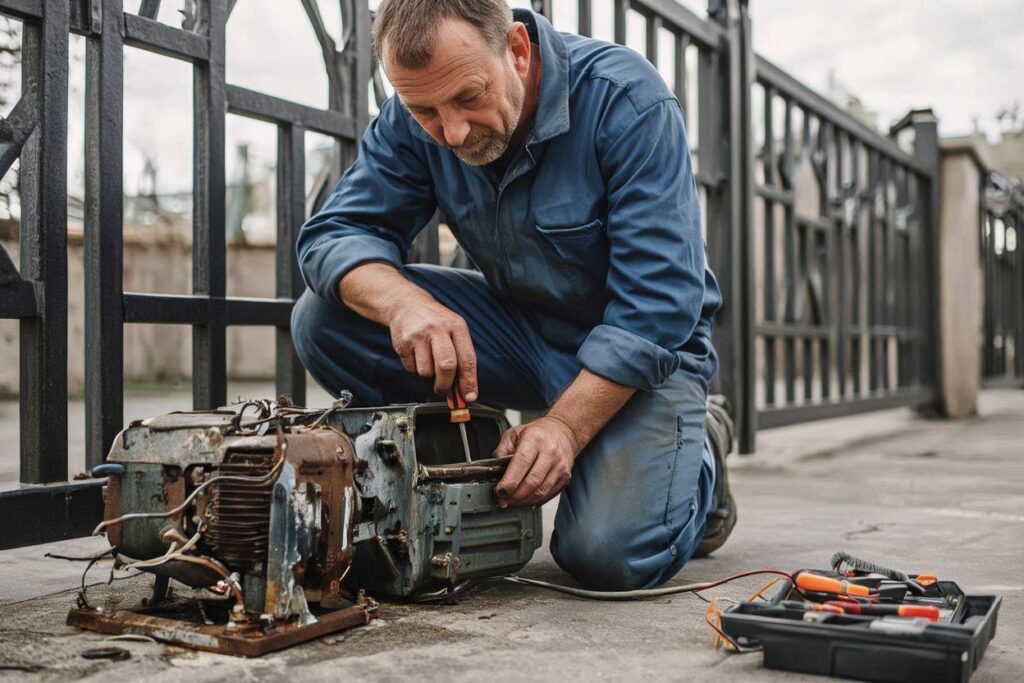
Crossing the threshold of your home after a long day at work should be a fluid, almost invisible gesture. An automatic gate represents the first point of contact with one’s home: a technology we take for granted until, suddenly, it stops working as it should. Whether it is an elegant swing gate or a practical sliding system, the motor is the beating heart of this convenience.
But like any electromechanical component exposed to the elements and daily wear and tear, even the most robust motor has a life cycle. A question arises spontaneously for many owners: “My gate is making a strange noise, do I need to change it or is a bit of grease enough?” Knowing how to distinguish between a simple need for maintenance and the necessity of a technological renewal is fundamental for the safety of your property and for your wallet.
In this complete guide, we will explore the revealing signs, risk factors, and innovations that make replacing an old system a choice for energy efficiency and living comfort today.
The Evolution of a Gate Motor’s Life Cycle
Time is the first factor to consider. An automation system installed over 15 or 20 years ago belongs to a completely different technological era. It is not just a matter of “old age,” but of construction standards and regulations.
The importance of the installation date
If your system was installed in the early 2000s, it is likely that it has already far exceeded average life expectations. A gate motor for residential use is designed to perform thousands of cycles (openings and closings). Once the 10-15 year threshold is passed, internal components such as gears, gaskets, and capacitors begin to show physiological degradation.
Furthermore, old electronic control units are much more vulnerable to voltage spikes and do not integrate modern standby energy-saving systems, silently weighing on the electricity bill.
5 Signs Your Motor Is Asking for “Help”
Often the gate does not stop working all at once; it sends us early messages that we should learn to interpret. Here are the main red flags:
- Unusual and Annoying Noises
A healthy motor emits a constant and fluid hum. If you start to perceive:
-
- Electrical humming without movement: Often indicates an exhausted capacitor or a problem with the motor windings.
- Electrical humming without movement: Often indicates an exhausted capacitor or a problem with the motor windings.
- Slowdowns and Uncertainty
The gate moves in “hiccups” or seems to struggle to complete its travel, especially on cold days. Does the cold thicken old lubricants? Yes, but a modern and well-dimensioned motor should not be drastically affected. If the slowness is constant, the electromotive force is dropping or internal mechanical friction has become unsustainable.
3.Lack of Fluidity in Swing Gates
In swing systems, if one of the two pistons moves slower than the other or if the leaves never reach the end of their travel simultaneously, we could be facing an oil leak (in hydraulic systems) or wear of the worm gear (in electromechanical systems).
4.The Gate “Reverses” Without Reason
Modern systems have amperometric sensors that block the motor if they detect an obstacle. If your gate stops or reverses its motion even if there is nothing on the track or between the photocells, it means that the mechanical effort required to move the leaf has become so high that it triggers the safety mechanism.
5.Too Frequent Repair Interventions
If in the last two years you have had to call a technician more than three times for small electrical faults, oil leaks, or board replacements, you are in the middle of the “final failure curve.” Spending money on repairs for an obsolete system is often less cost-effective than investing in a new, guaranteed kit.
Replacement vs. Maintenance: The Checklist to Decide
Not everything is meant to be thrown away. Sometimes, a targeted intervention can restore life to the system. Here is how to distinguish between the two situations:
When Maintenance is Enough:
- The gate squeaks but moves fluidly: Often it is enough to clean and grease the hinges or the rack.
- The photocells are not working: It is an alignment problem or the glass needs cleaning, not a motor issue.
- The remote control has poor range: Replace the batteries or check the receiver antenna.
- The system is recent (less than 7-8 years): In this case, a mechanical overhaul is almost always the right choice.
When Replacement is Necessary:
- Burnt motor: The cost of rewinding or replacing the motor part alone often approaches the cost of a new kit.
- Discontinued spare parts: If the manufacturer no longer exists or the model has been out of production for decades, finding parts becomes an expensive and risky endeavor.
- Safety not up to code: Old motors often lack obstacle detection and slowdown management functions, making the gate potentially dangerous for children and animals.
- Advanced corrosion: If the motor casing or the supports are heavily affected by rust, structural integrity is compromised.
Differences Between Sliding and Swing Gates
The choice of a new motor depends drastically on the type of opening.
The Sliding Gate
In this case, the motor works horizontally, dragging the leaf via a rack. The main wear factors are the pinion and the ground track. Replacing a sliding motor today means accessing Inverter technology, which allows for soft starts and stops, eliminating the jolts that shorten the life of the structure itself.
The Swing Gate
Here the effort is greater because the motor must overcome wind force and the weight of the leaf applied to the hinges. Replacing a swing motor often requires evaluating whether to move from an underground system (more aesthetic but subject to flooding) to an external piston system, which is easier to maintain and install.
Why Modernizing is Worth It (Beyond Functionality)
Replacing the motor is not just “repairing a fault,” but improving the quality of life. New automation systems offer:
- Extreme Quietness: Thanks to technical plastic materials and precision gears.
- Smart Integration: Ability to control the gate via smartphone or voice assistants.
- Certified Safety: Strict compliance with European EN 12453 regulations.
- Backup Batteries: To never remain locked out of the house even during a blackout.
Quality by VDS Automazioni: Made in Italy Excellence
When you come to the conclusion that replacement is the wisest path, the choice of a technological partner becomes crucial. In a market flooded with low-cost and short-lived solutions, VDS Automazioni stands out for an approach that combines Italian mechanical tradition with the most advanced electronic innovation.
Why choose VDS for your new gate?
- Integrated Production: VDS does not just assemble; it internally produces most of the components. This guarantees deep product knowledge and constant availability of spare parts over time.
- Versatility: Whether you have a small pedestrian gate or a massive industrial gate, VDS offers tailor-made solutions, from the sliding motors of the SIMPLY or CARRERA series to the robust pistons for swing gates like the EGO or PHV series.
- Technical Support: Choosing VDS means being able to count on a network of professional installers who know every technical detail, ensuring an installation according to the state of the art, which is fundamental to not invalidate the motor’s performance.
Making your home efficient and automated starts with the details. A gate that opens silently upon your arrival is the first sign of a well-cared-for and safe home. If your old motor shows signs of age, do not wait for it to block definitively under the rain or in the middle of the night.
Trust the experience and solidity of VDS Automazioni: Italian technology designed to last, move, and protect your spaces.