



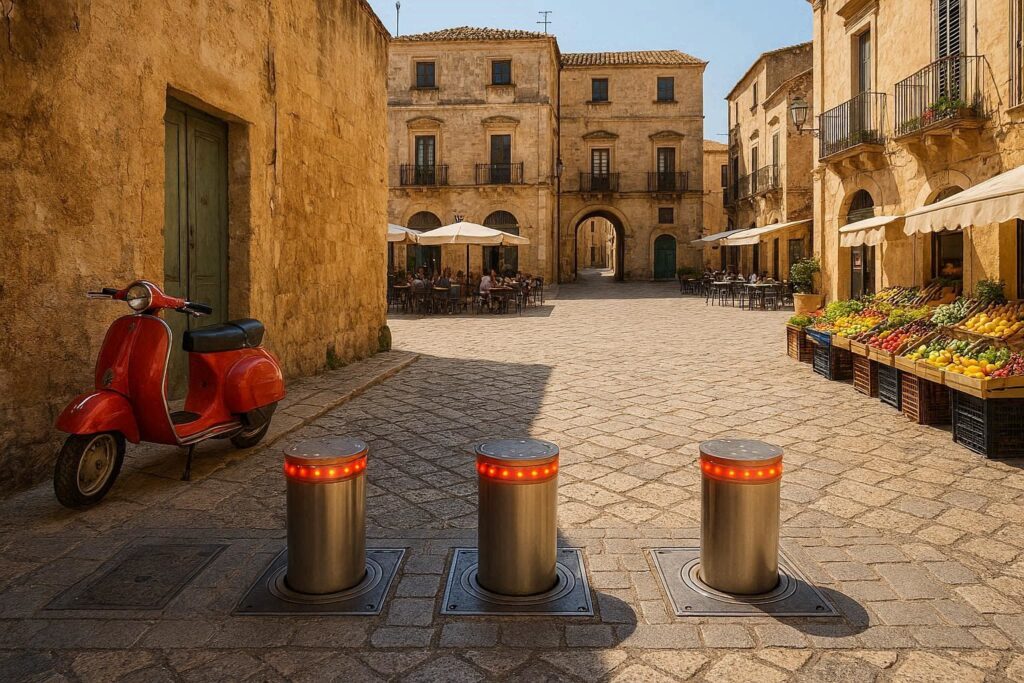
Italy preserves a historical, architectural, and cultural heritage that is unique in the world. Our historical centers, ancient villages, and cobblestone streets represent the deep soul of communities—testimonies of a past that continues to dialogue with the present. However, the growth of modern vehicular traffic has put a severe strain on these delicate areas. Streets designed centuries ago for pedestrian transit or horse-drawn carriages now find themselves bearing the load, pollution, and clutter of cars, vans, and motorcycles.
The contemporary challenge for public administrations, urban planners, and designers is not simply to ban access, but to requalify the urban fabric through intelligent flow management. Transforming a historical center into a pedestrian area or a Limited Traffic Zone (LTZ) does not mean isolating it, but rather restoring its value, safety, and livability. To achieve this effectively, protecting the right of residents to reach their homes while guaranteeing the passage of emergency vehicles, automation technology plays a fundamental role. The installation of automated physical barriers and intelligent traffic bollards represents the cornerstone of a sustainable urban transition, capable of combining respect for history with the demands of modern life.
The Value of Historical Centers and the Damage of Unregulated Traffic
Italian historical centers are not static, unchangeable open-air museums; they are living ecosystems made up of commercial activities, residences, offices, and social gathering spaces. When vehicular traffic invades these areas in an uncontrolled manner, negative effects manifest on multiple levels:
- Structural damage to historical heritage: Continuous vibrations caused by the passage of heavy vehicles or an excessive volume of cars damage the foundations of historical buildings, monuments, and ancient pavements (such as cobblestones, porphyry, or flagstones).
- Atmospheric and noise pollution: Exhaust gases accelerate the chemical deterioration of the facades of historical buildings and monuments (the “black crust” phenomenon), in addition to making the air unhealthy for residents and tourists. Engine noise disrupts the natural harmony and tranquility typical of ancient villages.
- Loss of commercial and tourist appeal: A historical center congested by wild parking or continuous traffic loses its natural vocation for hospitality. Pedestrians feel unsafe, shopping becomes stressful, and the outdoor tables of bars and restaurants lose their charm.
- Decline in the quality of life for residents: The difficulty of finding parking, noise stress, and dangerous streets push long-time residents to abandon the center, favoring a process of depopulation that impoverishes the very identity of the place.
Urban regeneration must therefore start from a clear premise: returning public space to people. Pedestrianization and the creation of well-defined LTZs are not punitive measures against motorists, but strategic investments in the economic, touristic, and social future of our cities.
Pedestrianization as a Driving Force for Urban Regeneration
Closing historical streets to traffic produces an immediate positive domino effect. Successful experiences in Italy and across Europe demonstrate that where cars make way for pedestrians, a true rebirth of the territory occurs.
Economic and Commercial Benefits
There is an old urban myth that “fewer cars mean fewer customers for shops.” Data proves the exact opposite. In pedestrianized streets, the foot traffic of passersby increases exponentially. People walking on foot have a significantly higher propensity to buy than those driving through in a car. Shop windows become more visible, walking becomes slow and relaxed, and local neighborhood businesses—from artisan boutiques to cafés—record an increase in turnover. The historical center returns to being the natural shopping mall of the city.
Environmental Sustainability and Public Health
Reducing motor vehicles drastically cuts emissions of CO₂ and particulate matter (PM10 and PM2.5). The air becomes more breathable, and citizens are encouraged to walk or cycle, promoting an active and healthy lifestyle. Furthermore, the reduction in noise pollution improves the psychological and physical well-being of those who live in and frequent the center.
Tourism and Cultural Enhancement
A historical center free of cars allows architectural beauties to be fully appreciated. Tourists can photograph squares and monuments without the visual interference of parked vehicles. The reclaimed urban spaces can host cultural events, artisan markets, open-air exhibitions, and events that enrich the municipality’s tourist offerings.
The Accessibility Dilemma: Protecting Residents
While the advantages of pedestrianization are clear, the main complexity lies in managing exceptions. A historical center cannot be completely sealed off. Specific categories must necessarily maintain the right of access, first and foremost residents.
Those who have chosen to live in the ancient heart of a town must be able to reach their homes to unload groceries, transport heavy loads, or accompany family members with reduced mobility. A far-sighted administration must guarantee this right without allowing the concession to turn into an abuse by outsiders. In addition to residents, access must be granted to:
- Emergency vehicles (ambulances, fire brigades, law enforcement).
- Public utility services (waste collection, maintenance of electricity and water lines).
- Vehicles for loading and unloading goods serving commercial activities (within strictly established time slots).
- People with disabilities holding a regular permit.
How can this perfect balance between total closure to the public and controlled openness to authorized users be achieved? Traffic signs and road markings alone are not enough. Administrative sanctions via cameras (so-called electronic gates) act ex-post: they fine the infraction after it has already occurred, but they do not physically prevent the unauthorized vehicle from entering, occupying the pedestrian space, and creating a potential danger. The solution lies in using automated physical barriers capable of communicating with intelligent access control systems.
Technological Tools for Urban Access Control
Physical control of an access point in a historical center requires solutions that meet three fundamental criteria: mechanical efficiency, electronic reliability, and low aesthetic impact. One cannot think of installing a monumental gate or a standard highway barrier at the entrance of a medieval street; it would destroy the visual harmony of the place.
This is where the experience of VDS Automazioni comes into play. As a leading Italian company in the design and production of automation systems for entrances, gates, traffic barriers, and bollards, VDS has developed a range of products specifically designed to integrate into the Italian architectural landscape, offering maximum security without altering the beauty of the surroundings.
The two main solutions for managing urban and historical access points are:
- Retractable traffic bollards.
- Automatic chain barriers.
Let us look closely at the characteristics and advantages of these VDS-signed technologies.
The MOLE Retractable Bollard: Invisible Automation
When the main objective is absolute respect for the architectural and environmental context, the MOLE retractable traffic bollard represents the ideal choice. This solution combines extraordinary mechanical robustness with minimal visual impact.
Technical Feature | MOLE VDS Bollard Specifications |
Operation | High-precision hydraulic / electromechanical |
Visual Impact | Virtually zero (flush with the pavement when lowered) |
Impact Resistance | High, designed to stop unauthorized vehicles |
Visual Signaling | Integrated LED ring on the cylinder head for maximum night visibility |
Surface Treatment | Corrosion-treated steel or satin-finished stainless steel |
Aesthetics and Landscape Integration
The great strength of the MOLE bollard is its ability to “disappear.” When the gateway is open (for example, for residents or during time slots allocated to suppliers), the metal cylinder lowers completely, positioning itself flush with the road pavement. There are no vertical obstructions, and no structures break the visual line of the street. When the gate closes, the solid cylinder rises vertically, creating an insurmountable block for any car. This discretion makes it the preferred product for Superintendencies of Architectural and Landscape Heritage.
Robustness and Mechanical Safety
The MOLE is not just an element of urban furniture, but a true security device. Built with highest-quality materials, it is designed to withstand impacts and ramming attempts. Its internal structure guarantees exceptional continuity of service, even in the presence of intensive use frequencies typical of access points to urban centers.
Technology and Signaling
To ensure the maximum safety of pedestrians and authorized motorists, the MOLE bollard is equipped with an LED light ring at the top. This luminous signaling is essential during night hours or in case of fog and poor visibility, clearly indicating the presence of the raised pillar. The raising and lowering movement is smooth, rapid, and coordinated by advanced electronic control units that manage accessory safety devices (such as underground magnetic loops, which prevent the bollard from rising if a vehicle is positioned over it).
The L’ALZO Chain Barrier: Versatility and Total Control
In many urban or road contexts, the characteristics of the pavement, the presence of underground utilities (gas pipes, electric cables, water networks), or the width of the gateway make the installation of a retractable bollard complex, as it requires a deep vertical excavation. In all these situations, the ideal solution is represented by L’ALZO, the automatic chain barrier designed by VDS.
What is VDS L’ALZO?
It is an automation system composed of two lateral pillars between which a high-resistance chain is tensioned. When the gateway is closed, the chain is raised and taut, physically preventing the passage of vehicles. When the gateway is opened, the automation guides the chain down into a special low-profile underground guide track, allowing the smooth transit of cars.
Optimization of Wide Gateways
L’ALZO is an incredibly versatile solution, capable of covering very wide access points where installing multiple vertical bollards would be expensive or technically complex. With a single chain system, it is possible to delimit access to entire squares, entrances to wide historical avenues, or wide-radius private roads.
Discrete and Traditional Design
The lateral pillars containing the motor and the control electronics are designed with clean, discrete lines. The finishes and colors are conceived to integrate harmoniously with classic urban furniture elements, such as cast-iron lampposts, benches, and planters. The chain itself recalls a traditional element of space delimitation, while transforming it into a modern, high-tech device.
Maximum Operational Safety
The L’ALZO chain barrier is equipped with electronic obstacle detection systems. If the chain encounters an obstruction during the lifting phase, the system stops immediately to prevent damage to things or people. It is the perfect solution to combine the need for physical closure with maximum operational safety in areas with high pedestrian density.
Management and Interface Systems: How Access Works for Residents
An excellent mechanical automation, whether it is the MOLE bollard or the L’ALZO barrier, needs an electronic “brain” to function intelligently. VDS Automazioni offers a complete range of command and access control systems that can be customized based on the specific needs of the municipality or private user.
Here are the main technologies that can be integrated to allow authorized residents unhindered passage:
- Rolling Code Remote Controls
Authorized residents receive a VDS remote control. The use of the Rolling Code system prevents signal cloning by malicious users, ensuring that only officially registered devices can activate the opening of the gate.
- RFID Cards and Proximity Badges
Another highly practical solution involves installing an access pillar equipped with a card reader. The resident brings their badge close to the reader without getting out of the car; the system recognizes the unique identifier and lowers the bollard or chain.
- Automatic Number Plate Recognition (ANPR) Systems
For total convenience and smooth traffic flow, the gate can be integrated with a license plate reading camera. The camera scans the plate of the approaching vehicle: if the plate is present in the whitelist of residents or emergency vehicles, the VDS automation activates instantaneously and automatically.
- Smartphone and App Control
Modern technology allows managing the opening of gateways via smartphone. Through GSM modules or Wi-Fi/Internet connections, the authorized user can send an opening command via a dedicated application or a simple, free phone call to a configured number.
- Emergency Management and First Responders
This is a critical point for public safety. VDS systems are prepared for integration with rapid emergency release devices. They can be connected to:
- Standardized key switches used by law enforcement and fire brigades.
- Siren acoustic detectors: intelligent systems that recognize the sound frequency of an approaching ambulance siren and order the immediate lowering of the barrier.
- Manual release systems in the event of a total power failure, easily operable by authorized operators.
Planning Urban Regeneration: Comparing Solutions
Every historical center has its own geographical, architectural, and structural peculiarities. The choice between a vertical retractable system and a chain barrier depends on a careful preliminary analysis.
To support designers and public administrations in their choice, we can summarize the application criteria in the following comparative table:
Selection Criteria | MOLE Retractable Bollard | L’ALZO Chain Barrier |
Access Width | Ideal for single or narrow lanes (can be installed in series) | Excellent for very wide access points with a single motor |
Required Excavation Depth | High (requires housing the cylinder underground) | Minimal (requires only a shallow surface guide track) |
Visual Impact | Zero (totally invisible when open) | Very low (traditional urban furniture style) |
Presence of Underground Utilities | Requires absence of pipes at the exact excavation point | Highly tolerant, does not require deep excavation |
Crash Resistance | Maximum, acts as a vertical impact barrier | Excellent for deterrence and control, flexible |
Beyond Historical Centers: Applications for Private Roads and Shops
While the requalification of public villages represents the application on the largest scale, VDS access control solutions also respond perfectly to private and commercial needs.
Private Roads and Residential Associations
Many private roads suffer from the phenomenon of “parasitic traffic”: motorists who use a private street as a shortcut to avoid traffic on main arteries, or outsiders who occupy parking spaces reserved for residents. Installing an L’ALZO chain barrier or a MOLE bollard at the entrance of the street clearly delimits private property, guaranteeing maximum tranquility and safety for the families living there.
Commercial Activities and Prestige Shops
Shops located outside large pedestrian areas, but which have internal courtyards, reserved parking spaces for customers, or loading and unloading areas, can protect their spaces from external abuse. A VDS bollard allows reserving passage only for owners, employees, or customers with special authorization, improving the image of order and prestige of the business.
Hospitality Structures and Hotels
Hotels located in historical centers or in panoramic areas of prestige need to welcome their guests by allowing temporary access for unloading luggage, while preventing entry to general traffic. With VDS automation systems, the hotel reception can manage access gates remotely, lowering the barrier upon the guest’s arrival and raising it immediately after.
Safety, Certifications, and Made in Italy Quality
Relying on VDS Automazioni means choosing the quality of a product entirely conceived, designed, and manufactured in Italy. Internal production allows rigorous control over every single phase of the process, from the selection of raw materials (high-strength steels, durable metal alloys, latest-generation electronic components) to final testing.
All VDS products strictly comply with the most stringent European regulations regarding automation safety. Safety concerns not only protection against intrusion, but also and above all the safety of pedestrians, children, and animals who frequent public areas. Anti-crushing systems, safety photocells, magnetic loop vehicle detectors, and integrated luminous signals ensure that the interaction between the automation and the urban space always takes place in conditions of absolute serenity.
Durability is another pillar of the VDS philosophy. Road automations are constantly exposed to atmospheric agents: rain, snow, frost, humidity, and high summer temperatures. Anti-corrosion treatments and the use of stainless steel finishes ensure that mechanical and aesthetic performance remain unaltered over the years, reducing routine and extraordinary maintenance costs to a minimum for municipalities and private individuals.
A New Model of Urban Livability
The requalification of a historical center is an act of love toward one’s territory and a fundamental investment for future generations. Freeing ancient streets from the grip of chaotic traffic, transforming squares into meeting places rather than improvised parking lots, and allowing residents to enjoy their homes in a safe and quiet environment are decisive steps toward an intelligent, human-scale city.
Technology must not be seen as an element of rupture with the past, but as the invisible and powerful tool that allows its preservation. Solutions like the MOLE retractable bollard and the L’ALZO chain barrier demonstrate how it is possible to govern mobility flows with elegance, precision, and total efficacy.
Every pedestrianization or LTZ creation project requires a careful study of local dynamics. There are no universal solutions, but there are tailor-made solutions capable of adapting perfectly to the geometry of a street, the restrictions of a historical heritage constraint, or the needs of a commercial activity.
Shape the Future of Your Historical Center with VDS Automazioni
Are you a public administrator wishing to enhance your municipality? A designer dealing with an urban regeneration plan? Or a private individual who wants to protect access to their road or commercial activity?
The VDS team of professionals and sales representatives is at your complete disposal to guide you in choosing the perfect automation system for your specific needs. We develop customized solutions capable of combining the highest technological performance with maximum respect for architectural decorum.
Book a consultation with our sales team today. Together, we will find the ideal solution to limit traffic, protect prestigious spaces, and grant only residents the unhindered and peaceful passage they deserve. Let’s start from people, let’s redesign access to our cities together.