



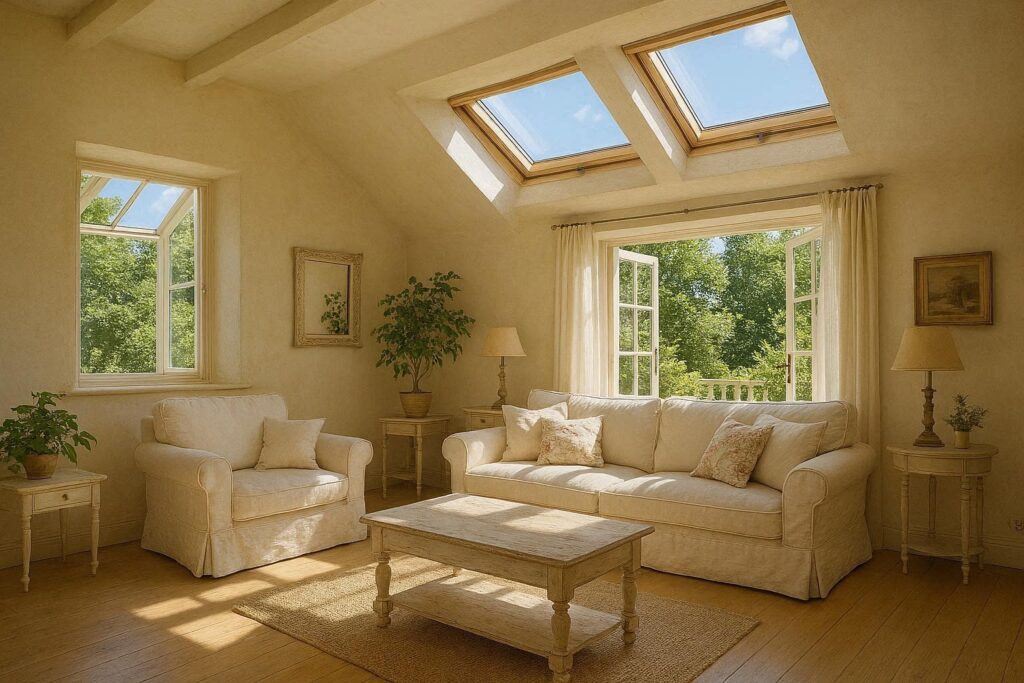
Summer is just around the corner and, along with long sunny days, it brings the challenge of managing heat inside our homes. When outdoor temperatures exceed 30 degrees, indoor environments risk turning into actual greenhouses, especially if the dwelling is spread over multiple levels or if there are attics, lofts, or rooms illuminated from above.
To maintain a cool, healthy, and pleasant house to live in without having to keep the air conditioner running all day at maximum power, the key is not only artificial cooling, but knowing how to manage natural ventilation. In this context, high-positioned light points—such as skylights, domes, and roof windows—play a fundamental role. However, their strategic position for air recirculation often coincides with maximum inconvenience of access. How many times do we give up opening them simply because they are too high up or because the operation requires the use of troublesome rods or ladders?
Transforming these fixtures from purely passive elements into smart and motorized systems radically changes the summer living experience. Let us see together why the motorization of high windows and skylights represents the definitive turning point for domestic comfort during the hottest months.
The Secret of Natural Cooling: The Stack Effect
To understand why high windows are so precious in summer, we must rely on a simple rule of physics: hot air is lighter than cold air and, consequently, tends to rise upwards.
When a house heats up during the day due to solar radiation, the heat accumulates right under the ceiling, on the roof, or on the upper floors. If the only open windows are at head height, the hot air remains trapped in the upper part of the rooms, creating that annoying feeling of a stifling, muggy heat blanket that makes it difficult even to rest.
If, instead, we simultaneously open the windows at the bottom (for example on the ground floor) and the skylights or high windows on the roof, an extraordinary natural phenomenon called the stack effect (or chimney effect) is activated. The hot air trapped at the top finds an escape route and shoots outside; this movement creates a slight negative pressure that draws cooler air from the windows positioned at the bottom.
The result? Constant, natural, and completely free ventilation, capable of lowering the perceived temperature by several degrees in a very short time, eliminating humidity and cooling the structure of the house.
The Concrete Advantages of Automating High Light Points
The stack effect is an incredible resource, but to exploit it fully takes consistency. Opening and closing skylights at the right times of day—such as early morning, late evening, or during the night—must be an immediate and effortless operation. Here are the main benefits obtained by automating these fixtures:
- Total Comfort and Barrier-Free Accessibility
The most obvious advantage is the elimination of any physical effort. A window positioned on a flight of stairs, on the ceiling of a double-height living room, or in an attic no longer requires dangerous acrobatics on ladders or the use of manual winders. With a motorized system, you just press a wall button, use a remote control, or touch your smartphone screen to manage the opening with millimeter precision.
- Smart Management of Night Ventilation
During summer nights, the outdoor temperature drops significantly. Leaving skylights or bottom-hung windows open during the night allows the house to “recharge” with coolness, cooling down the walls and floors that accumulated heat during the day. Automating these light points means being able to schedule night opening or being able to close them at dawn with a simple gesture from your own bed, before the sun returns to beat down hard.
- Well-being and Indoor Air Quality
In summer we tend to seal the house so as not to let the heat enter, but this leads to a rapid accumulation of carbon dioxide, humidity, and domestic pollutants (generated by cooking, cleaning products, or respiration). An automatic window system allows for quick and frequent air changes during the coolest hours, keeping the environment healthy, eliminating bad odors, and preventing the formation of mold in the dampest and warmest spots of the house.
- Energy Saving and Sustainability
The combined use of automated natural ventilation drastically reduces reliance on air conditioning systems. By exploiting the stack effect during the evening hours, the thermal load of the house is reduced: the air conditioner will have to work much less to reach the desired temperature, translating into a sharp cut in electricity bills and a lower environmental impact.
Skylights, Domes, and Windows: Which Fixtures Can You Motorize?
It is often thought that automation is a luxury reserved only for newly built homes or for fixtures designed for it from the beginning. In reality, modern technologies allow the motorization of almost any type of existing window frame, both in residential and commercial or industrial settings.
- Roof windows and skylights: They are the ideal candidates for automation. Being exposed directly upwards, they are the most difficult to reach but also the most effective for dissipating accumulated heat.
- Domes and continuous skylights: Typical of lofts, offices, industrial warehouses, or villas with a modern design. Their motorized opening allows large volumes of air to be ventilated in just a few seconds.
- Bottom-hung windows (or tilt-and-turn): Windows that open obliquely inwards, very common in bathrooms, corridors, or basements. Automation allows them to be kept open securely for constant ventilation.
- Top-hung windows: Windows that open outwards by pushing the lower side. They are perfect for letting air out without occupying space inside the room.
Technological Tools for Urban Access Control
Solutions by VDS Automazioni: Italian Technology at Your Service
To transform your windows and your light points into perfect allies against summer heat, VDS Automazioni has developed flexible, robust solutions with a clean design, engineered to adapt to any type of architectural and window frame need. For windows, skylights, and domes, the company offers two flagship products, capable of covering every scenario:
D8 FCE: The Linear Ram Actuator for Heavy Loads and Wide Openings
If you are dealing with heavy domes, large-sized skylights, or windows that require a vigorous push and a linear stroke, the VDS D8 FCE is the ideal answer. It is a rigid electric ram actuator, characterized by extraordinary mechanical resistance.
The main features of the D8 FCE include:
- High-resistance rigid ram: Designed specifically to resist tip and wind loads. This means that even in the event of strong headwind or particularly heavy fixtures, the ram does not undergo bending, ensuring smooth and safe opening and closure.
- Stroke flexibility: The D8 FCE is available in various extension variants to adapt perfectly to the desired ventilation width. You can choose versions with a maximum stroke of 200 mm, 300 mm, or 400 mm.
- Reliability over time: The internal mechanics are designed to last over time, reducing maintenance interventions to a minimum and guaranteeing quiet and constant operation.
Micro+: The Compact and Smart Chain Actuator for Bottom-Hung and Top-Hung Windows
For home windows, where aesthetics and compactness are fundamental, VDS Automazioni proposes the Micro+, a chain actuator with an elegant profile and advanced electronic functions. It is the perfect choice for top-hung and bottom-hung windows.
The main features of the Micro+ include:
- Overload protection system: Active safety that cuts off the power supply in case of obstacles, protecting both the motor and the window structure from potential damage.
- Automatic limit switch adjustment: Thanks to an ingenious magnet system, the actuator automatically recognizes the exact closing point, calibrating itself perfectly to the profile of your window fixture.
- Soft Stop Closure: In the final millimeters of the stroke, the motor slows down gently, smoothing its action. This arrangement avoids violent impacts, eliminates annoying impact noises, and preserves the integrity and lifespan of the seals and the window itself.
How to Choose the Perfect Automation for Your Home
The choice between a ram actuator like the D8 FCE and a chain actuator like the Micro+ depends mainly on the type of window and the aesthetic and functional result you wish to obtain.
Feature | D8 FCE (Ram) | Micro+ (Chain) |
Type of Window / Fixture | Domes, heavy skylights, sunshade blades | Bottom-hung windows, top-hung windows |
Key Strength | Very high resistance to tip and wind loads | Compact dimensions, discreet aesthetics, smart electronics |
Stroke / Opening | Fixed choice (200, 300, 400 mm) | Adjustable and flexible |
Visual Mechanism | Rigid linear ram that extends outwards | Articulated chain that disappears inside the motor body |
Safety Systems | Robust mechanical limit switches | Overload protection, magnetic limit switch, Soft Stop |
Relying on VDS Automazioni solutions means choosing the peace of mind of a product designed to improve everyday life. Making the light points of your home automatic is not just a choice of comfort, but a true investment in living well-being, environmental health, and the energy efficiency of your home ahead of the summer season.
Get ready to welcome the great heat with a fresh, ventilated, and smart home. Choose the technology and reliability of Made in Italy with VDS Automazioni.