



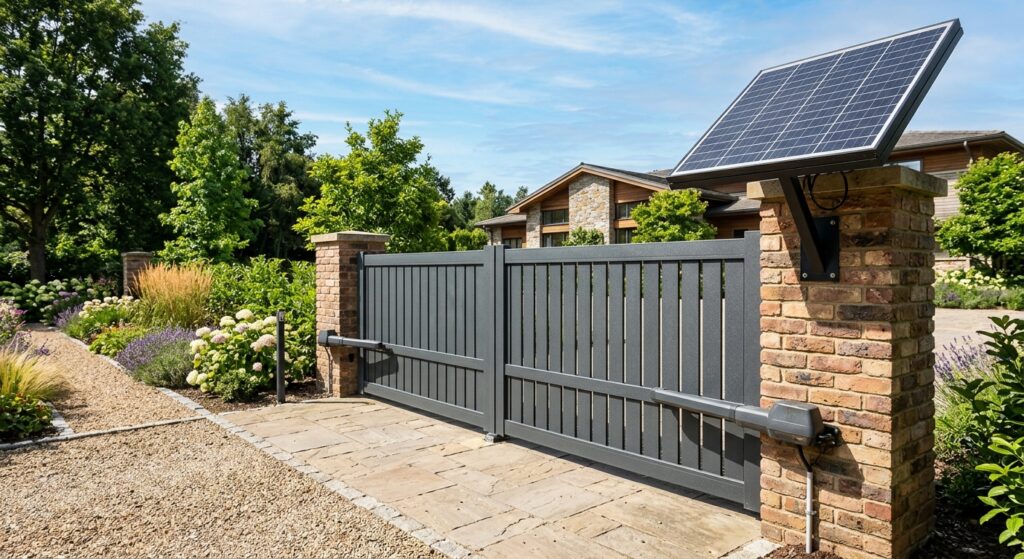
The technological evolution of entrance and access control systems is undergoing a profound transformation driven by the need to combine environmental sustainability, operational efficiency, and independence from the traditional power grid. In residential, commercial, agricultural, and industrial settings, automating sliding gates, swing gates, road barriers, and doors without invasive masonry work or heavy wiring costs has become a top priority.
The answer from VDS Automazioni—an Italian center of excellence in designing and manufacturing gate motors, road barriers, bollards, shutters, and window automation—lies in solar-powered solutions integrated with low-voltage backup batteries.
In this technical and operational deep dive, we analyze in detail how solar photovoltaic kits dedicated to gate automation work, their professional installation procedures, energy efficiency management, and all application scenarios where solar power is the winning choice.
1. How Solar Kits and Backup Batteries Work for VDS Motors
To understand the reliability of a solar-powered automation system, it is necessary to examine its engineering structure. A solar-powered automatic gate does not draw power directly from the solar panel during movement; instead, it utilizes a continuous storage circuit managed by a smart charge controller.
[ Photovoltaic Solar Panel ]
             │
             ▼
[ Smart Charge Controller ]
             │
             ▼
[ Backup Battery Pack (12V / 24V) ] ──► [ Low-Consumption VDS Control Unit ]
                                                     │
                                                     ▼
                                          [ VDS Motor / Actuator ]
Key Components of the VDS Solar System
Monocrystalline Photovoltaic Panel: Captures solar radiation (both direct and diffuse) and converts it into direct current (DC). High-efficiency monocrystalline cells ensure optimal energy production even on cloudy days or under suboptimal lighting conditions.
Smart Charge Controller: Serves as the brain of energy management. It constantly monitors the voltage coming from the panel and the battery charge status, preventing overcharging or deep discharge that could damage the batteries.
High-Capacity Backup Batteries (AGM or Lithium): Store the charge provided by the panel and deliver the current boost required to operate the motor.
Low-Power Electronic Board & Control Unit: The key factor for efficiency lies in the VDS control unit, engineered to reduce standby power consumption to virtually zero. When the gate is stationary, the control unit enters a deep sleep mode, consuming a negligible amount of energy to preserve battery power for opening and closing cycles.
12V and 24V Operation: Safety and Performance
VDS motors designed for solar power operate primarily at 24V Direct Current (DC). Compared to traditional 230V AC systems, 24V technology offers crucial advantages:
Torque Control and Deceleration: Enables smooth speed regulation, manages deceleration phases during closing/opening, and performs electronic impact control (encoder/anti-crushing safety).
High Inrush Current Output: Provides the necessary force to overcome initial inertia on large gates or heavy-duty road barriers without overstressing the battery.
Maximum Electrical Safety: The absence of high voltage along the cables eliminates the risk of electric shock during installation or maintenance, ensuring full compliance with European safety standards (EN 12453 and EN 12445).
2. Ideal Applications: Solutions for Remote Vurches, Second Homes, and the Agricultural Sector
Installing a traditional power line to feed a gate or road barrier often requires complex work: trenching, laying protective conduits, running armored cables, repaving, and handling administrative paperwork for new electrical meters.
Using VDS solar kits completely eliminates these costs, making it possible to automate any entrance in a very short time.
┌─────────────────────────────────────────────────────────────────────────────────┐
│                     COST AND INSTALLATION TIME COMPARISON                       │
├─────────────────────────────────┬───────────────────────────────────────────────┤
│ TRADITIONAL SYSTEM (230V)       │ VDS SOLAR SYSTEM (24V)                        │
├─────────────────────────────────┼───────────────────────────────────────────────┤
│ • Trenching and ground digging  │ • Zero trenching or repaving needed           │
│ • Electric meter / board setup  │ • No grid connection costs                    │
│ • Masonry and civil works       │ • Quick installation in a few hours           │
│ • Ongoing electricity bills     │ • Zero utility bill costs (100% Green)        │
└─────────────────────────────────┴───────────────────────────────────────────────┘
Second Homes and Vacation Properties
At countryside or seaside residences, the electrical meter is often deactivated or downgraded during off-season periods. An automatic gate tied to the traditional power grid would be unusable without an active contract.
Solar power guarantees full 365-day operation, allowing opening via remote control or key selector without relying on energy utility companies.
Agricultural Settings and Farm Estates
Farmhouses, field access points, barns, and agricultural estates span vast areas where the main electrical supply point may be hundreds of meters away from the main gate. Running a 230V line to the property entrance often costs far more than the motor itself.
VDS solar systems allow you to automate heavy sliding gates, warehouse doors, or entrance barriers without running a single meter of mains cable.
Remote Access Points and Community Entrances
Private roads, forest entrances, construction site access, and private parking lots benefit immediately from solar-powered barriers and bollards. The flexible positioning of the panel allows placing the access point exactly where needed, free from structural constraints.
3. Service Continuity, Autonomy, and Blackout Management
A common question concerns the reliability of solar power during prolonged periods without direct sunlight or in winter. VDS kits are sized to ensure a high energy reserve even under severe weather conditions.
How Many Cycles Can a Solar-Powered Gate Perform?
The autonomy of a backup battery system is calculated based on the number of complete open/close cycles performed daily.
Thanks to the efficiency of VDS electromechanical motors and ultra-low standby control boards:
A standard kit guarantees up to 30–50 cycles per day under full sun conditions.
Even in total absence of direct sunlight (heavy fog or continuous rain for several days), the 24V battery pack retains sufficient backup energy to guarantee over 20–40 full openings, preventing access lockouts.
Smart Blackout Management
While a traditional 230V system stops functioning during power outages or grid blackouts (forcing the use of a manual release key), a solar-powered gate operates completely off-grid.
Power outages in the area have zero effect on gate security or accessibility: your home or business remains protected and accessible at all times.
4. Installation Guide and Optimal Solar Panel Placement
Correct installation of the solar kit is crucial to ensure maximum battery lifespan and consistent energy production over time.
       [ Facing True South ]
                 ▲
                 │  30° - 45°
           ┌───────────┐
           │   PANEL   │
           └───────────┘
                 │
   [ Shading: None / Unobstructed ]
Golden Rules for Solar Panel Mounting
Strategic Orientation: In the Northern Hemisphere, the solar panel must face TRUE SOUTH. Any deviation toward East or West reduces daily energy capture efficiency.
Correct Tilt Angle: The optimal tilt angle relative to the horizontal plane ranges between 30° and 45°. A higher tilt (around 40°–45°) improves sun capture during winter months (when the sun is lower on the horizon) and helps rain and snow slide off the glass surface.
No Shading: Install the panel on a dedicated pole or on top of the gate pillar, ensuring that nearby trees, hedges, roof overhangs, or buildings do not cast shadows on the panel during peak daylight hours.
Cable Sizing: To minimize voltage drop between the solar panel, charge controller, and battery pack, use appropriately sized cables (minimum 2.5 mm²) and keep cable runs as short as possible.
5. Maintenance Tips to Maximize System Lifespan
VDS solar-powered kits require minimal maintenance, but periodic checks ensure consistent long-term performance.
Cleaning the Photovoltaic Glass
Dust, fallen leaves, bird droppings, or atmospheric residue reduce sunlight absorption. We recommend cleaning the solar panel surface at least once or twice a year using demineralized water and a soft, non-abrasive cloth.
Battery Health and Replacement
AGM/Gel batteries have an average lifespan of 3 to 5 years, depending on usage intensity and ambient temperature fluctuations. Periodically check the resting voltage of the batteries with a multimeter and replace them when they show signs of capacity degradation.
Checking Control Unit Seals
Because control panels and battery enclosures are installed outdoors, periodically check that cable glands and weatherproof seals maintain an IP-rated seal against moisture, insects, or small pests.
Choose Sustainability and Reliability with VDS Automazioni
Adopting a solar-powered gate automation system is a strategic choice on every front: it eliminates civil work costs, removes electricity bill expenses, protects the environment, and delivers total accessibility even without grid power or during blackouts.
With over 30 years of experience designing entrance, window, and barrier automation systems, VDS Automazioni offers products entirely made in Italy, tested to withstand harsh environmental conditions and built to last.
If you are looking to automate a gate, barrier, or remote access point without trenching or wiring work, explore the complete range of 24V VDS motors and matching solar power kits.
FAQ – Frequently Asked Questions about Solar Automations
Does the solar panel work on cloudy days or during winter?
Yes. VDS monocrystalline photovoltaic modules capture diffuse solar radiation even under cloud cover. Furthermore, the backup battery pack holds enough energy to bridge several consecutive days of poor weather.
Can an existing VDS gate motor be converted to solar power?
If the existing installation features a 24V DC motor and supports zero-standby control boards, it can be retrofitted with a VDS solar kit after technical verification by a qualified installer.