



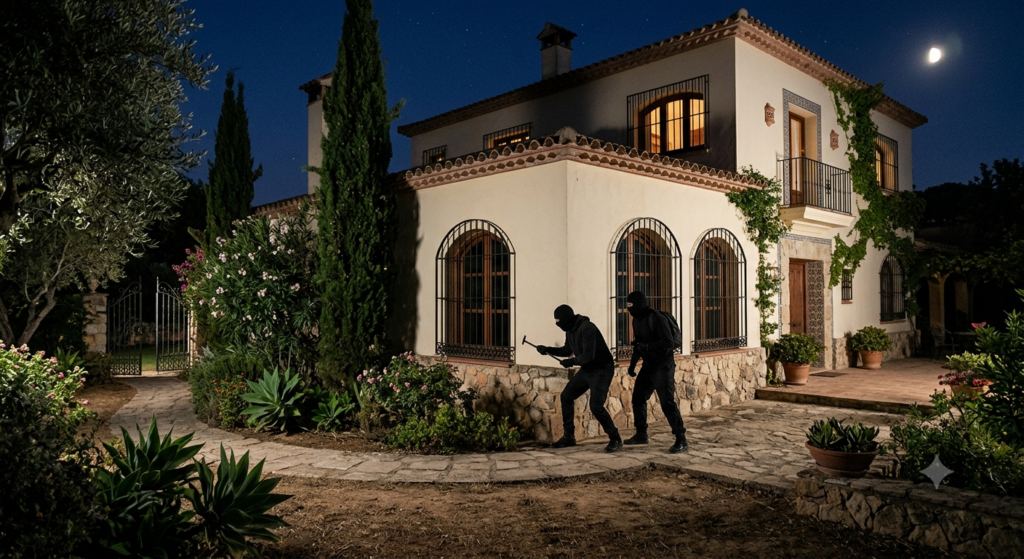
The arrival of summer vacations or a long weekend away brings a natural wave of excitement. However, for many homeowners, the joy of departure is often accompanied by a subtle layer of anxiety regarding the security of their property. Statistics show that periods of prolonged absence coincide with an increase in break-in attempts. Leaving a house visibly uninhabited—with roller shutters permanently lowered, lights off, or conversely, left on day and night in a clumsy attempt to simulate presence—is the first sign that intruders look for.
Modernizing the management of entry points and shading systems is no longer just a matter of pure comfort or technological prestige; it is a true strategy of passive and active defense. Integrating smart motorized systems allows you to transform a vulnerable home into a dynamic structure capable of reacting to weather events and simulating the daily presence of its residents, discouraging intrusion attempts before they even occur.
The Strategic Role of Automation in Burglary Prevention
Professional thieves often scout residential neighborhoods to map out the habits of the residents. A house frozen in time, where nothing moves for days, becomes a primary target.
The coordinated automation of gates, garages, roller shutters, and windows disrupts this static nature through three fundamental principles:
- Real Presence Simulation: Thanks to time programming and remote management, roller shutters can rise in the morning and lower at dusk, exactly as would happen if the family were at home.
- Elimination of Weak Points: A garage overhead door or a gate lacking a robust motorized lock can be forced open with relative ease. Latest-generation motors integrate irreversible mechanical locks that act as a true additional security lock.
- Environmental Responsiveness: A window or skylight left open by mistake before leaving can be managed automatically in the event of sudden storms or external threats, preventing both structural damage and facilitated access.
Management of Lighting and Sensitive Access Points: Focus on KINDI and KENDA
Within the product catalog for residential automation, the management of internal and external fixtures plays a crucial role. Windows, skylights, domes, and sun awnings are often the preferred channels for intruders to break into a property, as they are positioned in areas less visible from the street or wrongly considered less accessible.
To meet these specific movement and security requirements, the VDS Automazioni line of actuators proposes two landmark technological solutions: KINDI and KENDA.
KINDI and KENDA: Excellence in Roller Shutter and Awning Motorization
Within the residential automation solutions catalog, the management of shading and screening systems plays a crucial role. Roller shutters and sun awnings are often preferred channels for intruders to break into the property or to check for the presence of the residents, since their prolonged static state immediately reveals the family’s absence.
To meet these specific movement and security requirements, the VDS Automazioni line of tubular motors offers two landmark technological solutions: KINDI and KENDA.
KINDI: The Precise and Reliable Tubular Motor
The KINDI tubular motor represents the ideal choice for automating daily-use roller shutters and rolling window coverings. Designed to be inserted directly inside the winding roller, KINDI combines compact dimensions with high lifting torque.
When the house is empty, the mechanical robustness of this motor serves as a genuine deterrent: once the closing cycle is complete, the system exerts mechanical resistance that effectively counters forced manual lifting attempts from the outside. The precision of the limit switches ensures that the roller shutter remains perfectly sealed against the ground, eliminating structural weak points in the window fixture.
KENDA: The Ideal Power for Solar Screening Systems
For structures requiring advanced management and superior heavy-duty force—such as large external sun awnings or particularly heavy armored roller shutters—the KENDA motor delivers best-in-class performance.
KENDA is specifically engineered to withstand heavy workloads and the typical stresses of shading systems exposed to wind action. Its control electronics allow for smooth winding and always-perfect tensioning of the fabric or shutter. From a security perspective, the irreversibility of KENDA’s mechanical movement ensures that no external force can unroll or tamper with the protection, sealing the house during extended periods of absence.
The Accessories That Make a Difference: Control, Security, and Autonomy
A motor, no matter how powerful and robust, requires a “mind” and “sensors” to operate intelligently, especially when there are no people physically present to supervise the movement. Command, detection, and safety accessories elevate the property’s level of protection, coordinating automation based on weather factors and perimeter movements.
Climate Protection: Anemometer and Rain Gauge
During vacations, atmospheric factors can become unwitting allies to intruders or cause damage that reveals the owners’ absence (for example, a sun awning torn by strong winds immediately signals that no one is home to fix it).
- The Anemometer: This device constantly measures wind speed. If gusts exceed a pre-set safety threshold, the anemometer sends a priority signal to the control unit, ordering the immediate retraction of sun awnings driven by KINDI or KENDA motors.
- The Rain Gauge: Sensitive to the fall of the very first drops of water, the rain sensor commands the instantaneous closing of sun awnings and roller shutters. By preventing indoor flooding, it preserves the structural integrity of the building and stops any fixture from remaining open during a storm.
Control Interfaces: Multifunction Selectors with Display and Buttons
Programming security routines requires clear and accessible interfaces capable of managing complex scenarios before departing for vacation.
- Multifunction Selectors with Display: They represent the operational heart of localized home automation management. Through intuitive screens, the user can set automatic opening and closing schedules, monitor the status of every single entry point (open/closed), and activate “Vacation Mode”. This mode disables internal physical standard controls (preventing a thief from simply pressing a wall button to open everything if they break a window pane) and activates presence simulation routines.
- Buttons and Keypads: Positioned at strategic points, they allow manual control protected by passwords or coded keys, ensuring that only authorized personnel (such as a relative taking care of watering the plants) can gain access by temporarily disabling the security automations.
Active Protection Systems: Photocells and Amplifiers
In the ecosystem of automation for gates, barriers, and garage doors, the physical protection of people and material goods is primarily entrusted to photocells. During the owners’ absence, these elements prevent accidental impacts or mechanical blocks from damaging the motors or leaving the automation partially open due to an unforeseen obstacle.
Photocells: Invisible Light Barriers
Photocells work in pairs: a transmitter (TX) projects an invisible infrared light beam toward a receiver (RX). As long as the light beam is uninterrupted, the control unit considers the path clear and allows the gate or shutter to move. If the beam is cut by an obstacle, the system immediately halts the movement and reverses its direction.
From a burglary prevention perspective, positioning pairs of photocells at different heights prevents intruders from climbing over or crawling under standard sensors to tamper with the entry point.
Amplifiers for Photocell Pairs
In industrial settings or large residential estates where distances between gate pillars or perimeter walls are significant, the infrared signal of standard photocells can suffer attenuation due to fog, heavy rain, or dust accumulation on the lenses.
The amplifier for photocell pairs intervenes by increasing the power of the transmitted signal and improving the receiver’s filtering capacity. This ensures maximum operational continuity of the system, preventing false automation lockouts that could leave it stuck in an open position overnight, exposing the house to the risk of unauthorized entry.
A Dynamic House is a Safe House
Relying on the technological solutions of VDS Automazioni means choosing a holistic approach to residential security. The coordination between robust motor systems like KINDI and KENDA, climate analysis managed by anemometers and rain gauges, and the use of volumetric infrared and microwave detectors transforms the home from a static shell into a smart, reactive system.
Being able to monitor entry point status, program presence simulation scenarios, and rely on the mechanical reliability of components entirely designed to resist wear and break-in attempts allows you to enjoy your vacation with genuine peace of mind. Security cannot be improvised: it is programmed through the technological excellence of a leading partner in the automation industry.