



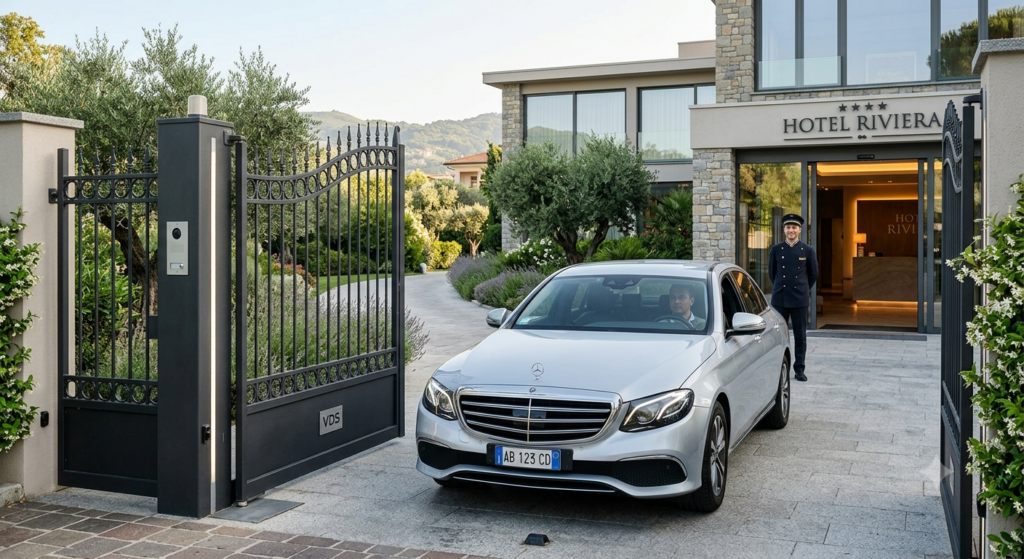
Hospitality reception is traditionally associated with the moment a guest steps into the lobby, meets the receptionist’s warm smile, breathes in the hotel’s signature fragrance, and receives their room key. However, from the analytical standpoint of the Guest Experience Journey, this perspective is fundamentally outdated.
The guest’s perceived journey does not begin at the front desk; it starts the exact second their vehicle pulls up along the perimeter of the property. This is precisely where a silent yet devastating threat to a hotel’s reputation manifests itself: The “Intercom Syndrome”.
This issue appears in the form of unjustified delays in front of a closed perimeter gate, crackling intercom speakers, slow or jammed automatic barriers, noisy motors, a complete lack of clear signage, and secondary entrances that resemble neglected construction sites. If a customer spends three minutes stranded on a public road pressing a button without an answer before a swing gate creeps open at a walking pace, their cortisol levels spike and their expectation of a five-star stay collapses before they even turn off the engine.
In this technical and strategic deep dive, we examine how entrance engineering, automation choices, and access flow management shape a hotel’s perceived value—and how solutions engineered by VDS Automazioni enable properties to turn critical access bottlenecks into assets of prestige, security, and operational efficiency.
1. The Psychology of Access: Neuroscience Behind the First Impression
The Primacy Effect in Modern Hospitality
In hospitality marketing, cognitive psychology has extensively documented the weight of the Primacy Effect: the initial information and sensory inputs an individual processes form the cognitive framework through which all subsequent experiences are evaluated.
If the guest’s first physical interaction with the hotel causes frustration, uncertainty, or a feeling of abandonment:
- The guest will judge subsequent minor imperfections (a brief delay during check-in or a room not quite ready) with significantly higher severity.
- The Perceived Value of the daily room rate drops instantly.
- The guest’s confidence in the overall safety and security of the property is compromised.
Clinical Definition of “Intercom Syndrome”: The collection of psychological micro-stresses experienced by guests who, after a long journey, find themselves blocked outside a property, unable to gain access in a smooth, autonomous, and elegant manner.
From Physical Gate to Brand Perception
A monumental wrought-iron gate or a minimalist modern barrier loses all its architectural charm if driven by grinding, slow, or thermal-clogged motors during peak arrival hours. Automation is not a mere mechanical construction component: it is the operational extension of the hotel’s hospitality philosophy.
Integrating high-performance, silent, and aesthetically refined automation systems establishes the hotel’s positioning as a modern, secure, and guest-centric establishment from the very first meter.
- Anatomy of Critical Access Points in Hospitality Properties
Eliminating the Intercom Syndrome requires systematically mapping all vehicular and pedestrian access points across the property.
- The Main Vehicular Gate (Swing or Sliding Gates)
As the primary gateway to the estate, typical issues encountered in legacy hotel gates include:
- Inadequate Operating Speed: Wait times exceeding 15–20 seconds create tailbacks on public roads and agitate arriving guests.
- Incorrect Motor Sizing: Standard residential-grade motors fitted on heavy hotel gates overheat during summer peak seasons under continuous use.
- Obtrusive Aesthetics: Bulky, unsightly mechanical arms that mar the architectural design of the gate.
- Parking Area & Flow Management (Traffic Barriers & Bollards)
Whether in luxury resorts, historic city-center boutique hotels, or high-traffic business hubs, parking access requires clear segregation between:
- Exclusive access reserved for staying guests and VIPs.
- Dedicated lanes for suppliers, staff, and logistical services.
- Pedestrianized or restricted traffic zones (ZTL) within hotel grounds.
Deploying high-speed automatic traffic barriers or retractable hydraulic bollards allows properties to secure perimeter boundaries without erecting harsh visual walls, preserving the elegance of the surrounding landscape.
- Underground Garages & Sectional Doors
Covered parking facilities serve as another touchpoint for quality perception:
- Acoustic Isolation: Garage door motors (for overhead or sectional doors) must not transmit vibrations or structural noise to guest rooms situated on upper floors.
- Continuous Duty Operations: A garage door for a 100-room hotel completes hundreds of opening/closing cycles daily. Non-continuous duty motors inevitably fail under high demand.
VDS Automazioni Solutions for High-End Hospitality
VDS Automazioni, an Italian company with decades of specialization in entrance automation engineering, delivers a complete suite of solutions tailored for the hospitality sector, manufactured to strict Made in Italy engineering standards.
- Swing and Sliding Gate Automations: Power, Smoothness, and Silence
To eliminate arrival delays, VDS engineers drive systems with high torque, precision mechanics, and advanced electronic control units.
- Sliding Gate Systems: Engineered to move gates of all sizes and weights (from lightweight aluminum frames to multi-ton industrial or historic structures). Equipped with encoder-based control units for millimeter-precise deceleration during opening and closing, ensuring smooth, judder-free motion.
- Swing Gate Systems (Electromechanical Arms, Hydraulic Rams, Underground Actuators):
- Underground Solutions: Perfect for historic estates, boutique hotels, and architecturally protected properties. The drive system is completely concealed beneath ground level, leaving the natural beauty of the gate untouched.
- Hydraulic Systems: The ultimate choice for heavy-duty gates requiring high hourly cycle rates. Hydraulic fluid guarantees heat dissipation, zero premature mechanical wear, and whisper-quiet operation.
High-Speed Barriers and Security Bollards
Dynamic parking management demands rapid performance:
Product Type | Typical Hotel Application | VDS Key Technical Advantage |
Automatic Barriers | Guest parking entrances, staff lanes, logistics access points. | Booms from 3m to 8m, rapid opening speeds, 24V low-voltage motors for continuous heavy duty, optional battery backup. |
Hydraulic Bollards | Internal ZTL boundary control, VIP lanes, anti-intrusion protection. | Fully retractable cylinders flush with ground level, integrated LED rings, high impact resistance, ultra-reliable hydraulic drive. |
Garage Door Automation: Discretion and Security in Basement Levels
VDS overhead and sectional garage door motors combine high-strength chain or belt drive systems with intelligent control units to deliver:
- Soft-Start / Soft-Stop: Eliminates structural vibration and noise propagation.
- Obstacle Detection: Fully compliant with European safety directives.
- Integrated LED Courtesy Lighting: Illuminates parking bays during guest night arrivals.
Expanding Guest Comfort Across the Property
While the initial impression starts at the gate, smooth automation must extend throughout the interior spaces: lobbies, VIP suites, conference rooms, wellness spas, and rooftop dining areas.
VDS Automazioni engineers motorized solutions for all window, door, and shading systems within the building envelope.
Motorized Roller Shutters and Blinds in VIP Suites
In luxury accommodation, uninterrupted rest is non-negotiable. VDS tubular motors for shutters provide:
- Centralized reception control (e.g., automatic shutter lowering upon guest checkout or “Welcome Home” scene activation when key cards are inserted).
- Silent operation that never disturbs guests in neighboring rooms.
- Protection and extended service life for window frames and blinds.
Automation for Sun Awnings and Pergolas in Outdoor Lounges
Outdoor dining terraces, poolside lounges, and breakfast patios generate high revenue for hotels. Automating awnings and shade structures with VDS motors integrated with anemometer (wind) and rain sensors delivers:
- Automatic retraction during sudden wind gusts, preventing catastrophic structural damage.
- Automatic deployment during peak sun hours to block thermal radiation, reducing indoor air conditioning loads and supporting Green Hospitality initiatives.
Microclimate Control: Skylights, Domes, and Automated Windows
In high-ceiling lobbies, atrium gardens, and spa centers, managing natural ventilation and daylighting is essential for indoor environmental quality. VDS chain, rack, and spindle actuators enable:
- Automated natural ventilation linked to ambient temperature and CO₂ sensors.
- Fast heat extraction from glass roof structures to combat greenhouse effect build-up.
- Full integration with the building’s fire safety and smoke extraction systems.
Comparison: Legacy Systems vs. Next-Generation VDS Automation
Feature | Legacy / Residential-Grade Systems | VDS Next-Gen Hotel Automations |
Avg. Gate Opening Time | 45 – 180 seconds (manual call, sluggish drive) | 3 – 8 seconds (high-speed drive, RFID/ANPR ready) |
Traffic Flow Impact | Tailbacks, street blockage, guest stress | Continuous flow, zero bottlenecks during peak hours |
Operating Noise | High mechanical grinding, structural vibration | Whisper-quiet motion with Soft-Start/Stop technology |
Safety Compliance | Higher risk of impact; weak obstacle sensing | EN 12453 compliant encoder control & optical safety edges |
Duty Cycle Rating | Prone to thermal cutout under heavy use | Continuous Duty rated (24V / 380V options) |
Smart / IoT Integration | Isolated, non-connected units | Full integration with PMS hotel software & access control |
Brand Perception | Dated, frustrating, unwelcoming start | Innovative, secure, elegant, and instantly welcoming |
Technical Engineering Guidelines for Hotel Designers and Facility Managers
The 4 Pillars of VDS Hotel Automation Engineering
- Regulatory Safety (EN 12453 & EN 12445): Full impact force regulation using smart encoder detection and synchronized infrared photobeams to eliminate collision hazards for pedestrians and luxury vehicles alike.
- Operational Continuity: Built with heavy-duty components—die-cast aluminum housings, stainless steel, bronze gearing, and synthetic hydraulic oils—preventing costly system failures during peak seasonal load.
- PMS Integration: Native compatibility with Automatic Number Plate Recognition (ANPR) cameras, Bluetooth/NFC digital mobile keys, and RFID keycards.
- Emergency Power Protocols: Integrated battery backup units and ergonomic key release mechanisms ensure uninterrupted gate functionality during municipal power outages.
Case Scenario: Transforming Guest Arrival at “Grand Hotel Riviera”
To understand the practical impact of resolving Intercom Syndrome, let us review an operational transformation achieved at a luxury resort property.
Initial State (Before Upgrade)
An 80-room seaside hotel used a 15-year-old residential single-phase motor on its main wrought-iron entry gate, paired with a standard intercom column located along the driveway.
- Operational Bottleneck: During peak afternoon check-in hours, up to 6 vehicles queued on the main road. The gate took 22 seconds to open. Reception staff had to repeatedly interrupt check-in procedures to answer crackling intercom calls and press manual release buttons.
- Guest Experience Impact: Hectic arrivals, horn-honking from road traffic, and an immediate sense of poor organization before stepping into the lobby.
VDS Engineering Upgrade
- Main Gate Motor Replacement: Installed a heavy-duty 24V VDS high-speed motor with encoder position sensing. Gate opening time dropped from 22 seconds to 6 seconds.
- Fast Parking Barrier Addition: Created a dedicated lane for pre-registered guests using a fast VDS barrier arm (1.8-second operation).
- ANPR Integration: Linked VDS controller boards to the hotel’s PMS to automatically open gates upon recognizing guest license plates gathered during pre-arrival registration.
Measurable Results
- Zero Arrival Queues: Recognized guest vehicles transition smoothly from public roads without stopping at an intercom.
- 85% Reduction in Reception Interruption: Front desk personnel remain focused on in-person guest service.
- Review Score Increase: Direct increase in positive guest reviews concerning arrival, parking, and overall technological sophistication.
- Checklist: Engineering Hotel Entrances Without Design Errors
- Calculate Peak Traffic Volumes: Account for guest arrivals, staff commutes, laundry trucks, and supply deliveries during peak hours. If hourly cycles exceed 20 transits, always select 24V or Hydraulic continuous duty systems.
- Segregate Pedestrian & Vehicular Routes: Never force walking guests through active vehicle swing paths. Provide a dedicated pedestrian gate with a silent hydraulic door closer and electric strike lock.
- Ensure Power Resilience: Always spec internal battery charger cards or UPS power backups so gates operate during grid outages.
- Prioritize Corrosion Resistance: For coastal or alpine locations, specify polyester powder-coated aluminum or stainless steel enclosures to resist salt spray and harsh weather.
Conclusion: An Unforgettable Stay Starts at the Gate
Exceptional hospitality relies on the seamless elimination of friction across every touchpoint. Underestimating the importance of the property’s perimeter access leaves hotels vulnerable to The Intercom Syndrome, turning what should be a moment of luxury and welcome into a source of stress.