



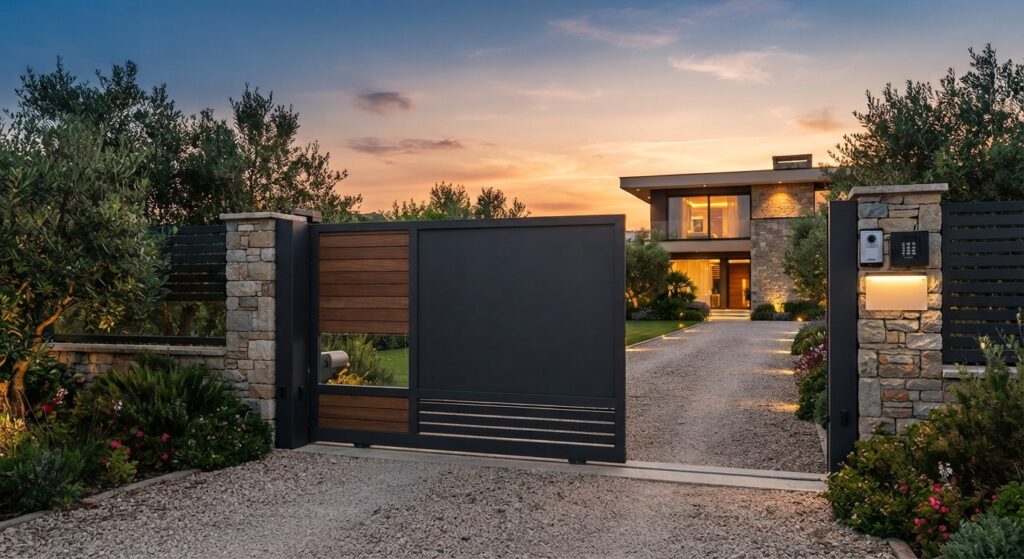
Every time we press the remote control button to enter or exit our driveway, or when a company unlocks access for suppliers through an automated system, a complex electromechanical chain is activated. Yet, we rarely pause to reflect on a fundamental question: how much does this daily gesture actually weigh on our electricity bill? In the current economic climate, where energy costs represent a decisive expense for both family budgets and the economic management of condominiums, businesses, and public entities, every single appliance and technological device installed on properties is subjected to a rigorous efficiency review.
VDS Automazioni, a leading Italian company in the design and production of systems for automating entrances and gates, road barriers, bollards, roller shutter motors, awnings, skylights, domes, windows, and garage doors, responds daily to requests from installers, entities, and end customers focused on energy savings. The goal of this technical and informative in-depth guide is to analyze in a transparent, scientific, and detailed manner the real consumption of an automatic gate, dispel false myths, examine the factors affecting annual expenses, and provide concrete optimization strategies for professional installers and end users.
1. The General Picture: How an Automatic Gate Works and Where It Consumes Energy
To understand the energy impact of an automation system, we must first analyze the nature of the devices that make up the installation. A modern automatic gate is not a passive element that continuously draws current; on the contrary, it is an intelligent system that lives primarily on standby and activates only for well-defined fractions of time.
Key Components and Their Power Draw
- The Control Unit (Electronic Board): This is the “brain” of the system. It remains constantly powered in standby mode to receive radio signals from remote controls, requests from access control systems, and commands from photocells, safety edges, and push-button panels.
- The Gearmotor (Electromechanical Actuator): This represents the “muscle” of the system. It can be 230V or low-voltage 24V. It activates exclusively during opening and closing phases, drawing the maximum nominal power declared by the manufacturer.
- Safety and Signaling Accessories: Photocell receivers, flashing lights (often LEDs in VDS’s latest generation products), key selectors, and external radio receivers.
From an energy perspective, the overall cost of an automation system derives from the combination of two distinct factors:
- Standby consumption: The energy absorbed 24 hours a day, 365 days a year, when the gate is stationary.
- Maneuver consumption: The energy concentrated in the few seconds required to complete the opening or closing of the leaf.
We will analyze both parameters to understand where waste hides and how to intervene.
2. Quantifying the Expense: Real Calculations for Homes, Condominiums, and Businesses
To provide a concrete answer to the question “How much do I spend on my bill?”, we must translate electrical power into kilowatt-hours (kWh) and apply average electricity tariffs.
Standby Consumption: The Silent Cost
Many users are unaware that an electronic device connected to the power grid continues to consume energy even when it is not performing mechanical work. A traditional control unit, especially if dated or equipped with traditional transformers and always-on displays, can constantly absorb between 5W and 15W.
Calculation hypothesis for a 10W standby power draw:
- Daily consumption: $10\text{ W} \times 24\text{ h} = 240\text{ Wh/day}$ ($0.24\text{ kWh/day}$).
- Annual consumption: $0.24\text{ kWh} \times 365 = 87.6\text{ kWh}$ per year.
Considering an average electricity cost for domestic or condominium use of approximately €0.25/kWh, the standby expense alone amounts to around €21.90 per year for a single unit—a figure that can double in obsolete systems with 20W absorption.
Maneuver Consumption: Kinetic Energy
The motor of a sliding or swing gate operates for a limited time. Let us assume an average maneuver lasting 20 seconds for opening and 20 seconds for closing (totaling 40 seconds per transit).
Calculation hypothesis for a 350W motor (typical for residential gates):
- Energy per single maneuver (opening + closing): $350\text{ W} \times (40 / 3600)\text{ h} = 3.88\text{ Wh}$ ($0.00388\text{ kWh}$).
Now, let us consider three different usage scenarios:
- Scenario A: Single-family home (Low residential use)
- Daily transits: 8 complete open/close cycles.
- Annual maneuvers: $8 \times 365 = 2,920$.
- Annual consumption for maneuvers: $2,920 \times 0.00388{ kWh} = 11.33$ per year (approximate cost: €2.83).
- Total annual (Standby + Maneuver): Approximately €24.73.
- Scenario B: Medium-sized condominium (Intensive residential use)
- Daily transits: 100 complete open/close cycles.
- Annual maneuvers: $100 \times 365 = 36,500$.
- Annual consumption for maneuvers: $36,500 \times 0.00388= 141.62$ per year (approximate cost: €35.40).
- Total annual (Standby + Maneuver): Approximately €57.30 (to be split among condominium residents).
- Scenario C: Public entity or business (High-traffic commercial/industrial use)
- Daily transits: 300 transits among employees, clients, and couriers.
- Annual maneuvers: $300 \times 365 = 109,500$.
- Use of a high-performance three-phase or 24V industrial motor (average power 600W).
- Energy per single maneuver (40 sec): $600{W} \times (40 / 3600){ h} = 6.66{Wh}$ ($0.00666\ kWh}$).
- Annual consumption for maneuvers: $109,500 \times 0.00666{ kWh} = 729.27{ kWh}$ (approximate cost: €182.31).
- Adding slightly higher standby consumption for advanced control units with complex peripheral management (e.g., 15W, equal to $131.4{ kWh}$ per year / €32.85).
- Total annual: Approximately €215.16.
As the data shows, the pure electricity cost is not prohibitive in itself; rather, the true economic impact stems from hidden waste, mechanical malfunctions that increase motor strain, and the intrinsic efficiency of modern electronic components compared to older systems.
3. Hidden Factors That Drive Up Energy Consumption
Why do some installations record electricity bills higher than calculated averages? Often the cause does not lie in the motor itself, but in a series of installation and maintenance issues that professional installers can identify promptly.
Mechanical Friction and Misalignments
A sliding gate with worn bearings, tracks dirty with debris, or a rack that is not perfectly aligned forces the gearmotor to perform extra effort to overcome mechanical resistance. The same applies to a swing gate with seized or poorly lubricated hinges.
When the motor works under prolonged strain, current absorption spikes. If the system is 230V, amperage draw increases; if the system is 24V, thermal protections or control circuits detect the obstacle, but the starting phase requires repeated energy peaks which, added up over the year, negatively impact energy balance and prematurely wear out motor windings.
Obsolete Control Units
Older electronic control boards designed decades ago utilized circuit components that dissipated a significant amount of energy as heat even during long periods of inactivity. A control unit lacking energy-saving logic (Power Saving) continues to keep relays and linear transformers active, wasting dozens of kilowatt-hours a year without any practical utility.
Always-on or Oversized Courtesy Lighting Systems
Many installations feature signaling lamps or courtesy floodlights connected directly to the control unit’s auxiliary output. If old 40W or 60W incandescent or halogen bulbs are used and remain lit for several minutes after every nighttime maneuver, the energy consumption of these lamps quickly surpasses that of the motor itself.
4. VDS Technological Solutions to Maximize Efficiency
VDS Automazioni constantly invests in Research and Development to offer advanced engineering solutions on the market that minimize energy consumption while guaranteeing superior performance, long-term reliability, and compliance with European safety and energy performance regulations.
24V Technology: Efficiency, Precision, and Low Consumption
The adoption of low-voltage gearmotors (24V) represents one of the most effective answers to energy saving and safety requirements.
- Intelligent Energy Management: VDS control units paired with 24V motors modulate power delivery based on the actual workload, reducing energy waste during acceleration and deceleration phases (millimetric slow-downs).
- Integration of Backup Batteries: In the event of a blackout, 24V systems can be powered by emergency accumulators that guarantee dozens of maneuvers without the need to restart generators or consume grid energy inefficiently.
Latest Generation Control Units with Power Saving Function
Electronic boards produced by VDS integrate low-absorption standby circuits. Thanks to ultra-low-power microcontrollers and intelligent peripheral management (photocells and safety devices activate only when necessary or reduce polling clock speeds), standby consumption is reduced to an historical low, dropping in many models to fractions of a watt.
Integrated LED Lighting
Replacing old incandescent signaling lamps with VDS LED-technology flashing lights and courtesy illumination systems cuts service light consumption by over 80%, offering superior brightness, an estimated lifespan of tens of thousands of hours, and total absence of extraordinary maintenance.
5. Practical Advice for Installers and Maintenance Technicians: How to Guide the Customer Toward Savings
The role of the professional installer goes far beyond simple mechanical assembly and electrical wiring. They act as an energy consultant capable of offering added value to the end customer (whether a private individual, condominium administrator, or technical manager of a public entity). Here is an operational checklist to optimize system efficiency:
- Schedule Periodic Preventive Maintenance
- Annually check leaf alignment and the wear status of bearings, tracks, and pins.
- Lubricate mechanical components with specific products recommended by VDS to prevent increased friction and subsequent abnormal motor strain.
- Check photocell efficiency: a dirty or misaligned sensor sends anomalous signals that can restart control cycles or keep auxiliary circuits active.
- Choose the Correct Automation Based on the Duty Cycle
- Do not oversize or undersize the actuator. Installing a residential-class motor on a high-traffic condominium gate forces the system to work constantly at the limit of its thermal and energetic capabilities.
- Select motors dimensioned according to actual weight and estimated transit frequency (cycles per hour), carefully consulting VDS technical catalogs.
- Educate the End Customer on Mindful Use
- Avoid repeated and unnecessary openings and closures.
- Verify the correct closure of auxiliary contacts and the absence of power leaks in the electrical system upstream of the control unit.
- Program automatic closure functions with calibrated timings where possible to prevent the gate from remaining open longer than necessary in areas subject to drafts or thermal shifts that can influence mechanical limit switches.
6. Beyond the Gate: Energy Efficiency Extended Across the Entire VDS Range
The concept of energy efficiency and savings is not limited exclusively to automatic gates for residential or industrial entrances. VDS Automazioni’s production ecosystem includes a vast range of solutions designed to improve living comfort and reduce the overall energy consumption of buildings, whether residential, commercial, or public.
Motorized Awnings, Roller Shutters, Skylights, and Windows
Intelligent automation of solar shading (awnings, roller shutters, shutters) plays a crucial role in building energy ratings (EPC/APE).
- Passive Heat Control: In summer, the automatic operation of awnings and shutters during peak sunlight hours prevents sun rays from directly striking window glass, drastically reducing internal thermal loads and limiting the energy-heavy use of air conditioners.
- Winter Solar Gain: On sunny winter days, the programmed or automatic opening of roller shutters allows exploitation of natural solar radiation to heat indoor environments, lowering heating energy consumption.
- Controlled Natural Ventilation: Automating skylights, domes, and windows allows setting nighttime cooling cycles (free cooling), utilizing fresh night air to lower internal temperatures in commercial or industrial buildings without consuming energy for daytime mechanical air conditioning.
Road Barriers and Bollards for Businesses and Entities
In high-traffic access points for public entities, corporate parking lots, and ZTL (traffic-restricted) zones, VDS automatic road barriers and bollards guarantee high duty cycles with optimized consumption thanks to direct current gearmotors and last-generation microprocessor control boards, minimizing impact on the energy bills of local authorities and businesses.
7. Conclusions: Investing in Efficiency Today to Save Tomorrow
Analytical calculations demonstrate that although the direct energy consumption of an automatic gate or a VDS automation system has a limited impact on global utility bill expenses (varying on average from a few dozen euros per year for residential users to proportionally higher figures for large condominiums and entities), the true battle for savings is fought on component quality, prevention of mechanical waste, technological upgrading of control units, and the use of low-impact technologies.
For professional installers, offering clients high energy-efficiency VDS automation systems, 24V motors, electronic boards with Power Saving functions, and LED lighting devices means offering a winning sales argument: reliable, safe systems compliant with European regulations capable of reducing management costs over time.
For end customers, choosing VDS Automazioni means investing in a 100% Italian product designed to last over time, combining daily comfort with the awareness of intelligent and sustainable energy management.