



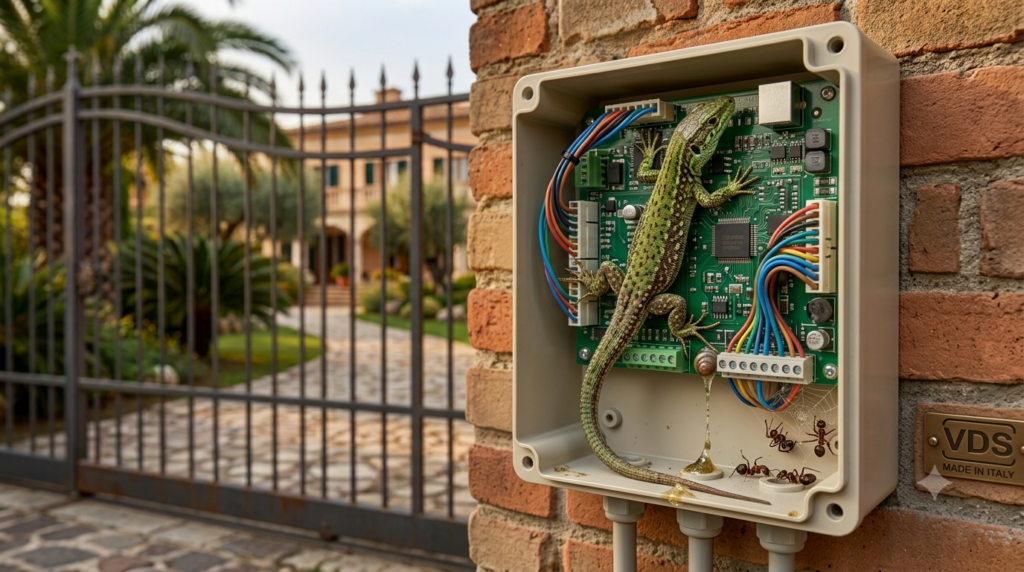
An automatic gate that suddenly stops responding to remote commands, a fuse that trips repeatedly, or a control board completely powered off for no apparent electrical reason: in the vast majority of cases, the root cause is not a manufacturing defect or a power surge. The real threat to the longevity of gate automations lies in a silent yet constant presence in our gardens and driveways: reptiles, insects, and small rodents.
Lizards, geckos, ants, snails, and spiders view control board enclosures as the ideal habitat: environments sheltered from rain, warm due to heat dissipation from components, and protected from predators. However, contact between animal biology and high-precision electronics almost always results in catastrophic consequences for printed circuit boards (PCBs).
Understanding how these small pests manage to penetrate control units and which technical measures to adopt is crucial for ensuring system reliability over time and preventing costly emergency maintenance calls.
The Problem: Why Small Animals Will Always Choose Your Control Unit
To effectively protect an installation, one must first analyze the phenomenon from a behavioral and microclimatic perspective. A control panel for automatic gates, barriers, or garage doors is not simply a plastic box mounted on a wall or housed inside a motor cover; it is a perfect micro-ecosystem for garden fauna.
The Thermal Factor and Heat Dissipation
Printed circuit boards (PCBs) in control units feature transformers, power relays, microcontrollers, and radio frequency modules. Even when the automation is in stand-by mode, the power transformer generates constant residual heat. During autumn and winter months, or simply during cold summer nights, the temperature inside the box is significantly higher than outside. Lizards and geckos, being ectothermic (cold-blooded) animals, are magnetically attracted to these heat sources to regulate their body temperature.
Shelter from Predators and Darkness
Protection enclosures offer a dark, draft-free shelter. For insects such as ants, earwigs, and spiders, the gaps around cable glands or frame crevices provide safe niches to nest or lay eggs.
The Food Chain Inside the Box
The phenomenon follows a precise chain reaction:
- Light and LEDs: Status indicator LEDs on the circuit board emit a faint light visible outside through the plastic housing or cable entries.
- Phototactic Insects: Midges, moths, and ants squeeze inside, attracted by light or warmth.
- Predators: Lizards and geckos sense the presence of insects and enter the box to hunt, turning the electrical panel into their private hunting ground.
The Mechanics of Damage: What Happens When Biology Meets Electronics
The intrusion of a reptile or insect inside a 230V (or even 24V low-voltage) control board triggers immediate or progressive destruction processes.
┌───────────────────┐
│ Heat Source (Transformer) │
└───────────────────┘
│ Attraction
▼
┌───────────────────┐
│ Entry of Insects and Small Reptiles │
└───────────────────┘
▼ ▼
┌───────┐ ┌─────┐
│ Direct Short Circuit │ │ Corrosion from Humus │
│ (Line-Neutral/Traces)│ │ Excrement & Slime │
└───────┘ └──────┘
│ │
▼ ▼
┌───────────────────┐
│ Irreversible Control Board Failure │
└───────────────────┘
- Short Circuit via Conductive Bridge (Direct Short)
The body of a lizard or gecko consists predominantly of water and mineral salts, making it an excellent conductor of electricity. When the animal steps across the back of the printed circuit board—where component solder pins are exposed—or between high-voltage (230VAC) traces and low-voltage logic (5V/12V/24V) paths, it creates an instant electrical bridge.
- Line to Neutral: Causes an immediate short circuit, blowing copper traces, destroying power relays, and tripping circuit breakers or protective fuses instantly.
- Low Voltage / Microprocessor: If a lizard simultaneously touches a 230V trace and a microprocessor pin, mains voltage discharges directly into the control logic, destroying the main chip and rendering the board completely unrepairable.
- Chemical Corrosion from Excrement and Slime
Not all pests cause an immediate short circuit. Snails, slugs, and ants cause medium- to long-term damage:
- Snails and Slugs: Moving across the board, they leave a trail of hygroscopic slime. This residue absorbs moisture from the air and creates high-resistance paths that slowly oxidize component leads, breaking copper traces and causing intermittent faults (unexpected gate openings, photocell lockups, logic errors).
- Ant Nests: Ants tend to carry soil, sand, and organic matter inside the enclosure to build nests. This accumulation creates a moist, conductive mass directly over electronic components, causing triacs or MOSFETs to overheat and fail.
Critical Access Points: How Do They Get In?
In sliding gate, swing gate, barrier, and overhead door automations, recurring entry points must be identified and sealed during installation or maintenance.
Access Point | Main Cause | Species Involved |
Conduits and Corrugated Pipes | Lack of sealing at cable pipe outlets coming from underground. | Lizards, Geckos, Rodents, Ants |
Loose Cable Glands | Cable glands left open or improperly sized for the cable diameter. | Insects, Small Reptiles |
Rear Mounting Holes | Box wall-mounted without rubber sealing washers on anchor screws. | Geckos, Spiders |
Cover/Housing Fit | Plastic warping over time or missing/damaged weather gaskets. | Earwigs, Snails |
Condensation Drain Holes | Bottom drainage holes left without protective mesh screens. | Insects, Small Lizards |
Professional Prevention and Installation Best Practices
Protecting an electronic control unit requires an integrated approach that combines proper mechanical installation, correct material selection, and specific design choices.
- Hermetic Sealing of Underground Conduits
The primary entry route for fauna and moisture is directly through underground conduits. The temperature difference between deep soil and the interior of the box creates a “chimney effect” that pushes humid air and pests upward.
- What NOT to do: Avoid standard single-component polyurethane foam. Over time, polyurethane foam degrades, absorbs moisture, and is easily chewed away by rodents or ants.
- What TO do: Apply high-density neutral silicone sealants or re-enterable two-component insulating gel designed for electrical junction boxes at the conduit entrance. The gel hermetically seals cable passages, preventing access by pests and moisture while allowing cables to be added or removed in the future.
- Meticulous Cable Gland Management
Every cable entering the control unit box must pass through a cable gland equipped with a rubber seal sized correctly for the cable’s outer diameter (e.g., PG9, PG11, PG13.5).
- Any unused cable gland must be fitted with dedicated blanking plugs and never left open.
- When multiple cables pass through a single gland (a discouraged practice, though sometimes unavoidable), fill voids with insulating sealing putty to prevent micro-gaps.
- Conformal Coating and Tropicalization
Leading automation manufacturers and qualified installers apply protective coatings directly to printed circuit boards. Conformal Coating (or tropicalization) involves applying a thin layer of transparent acrylic, silicone, or polyurethane resin over the board assembly.
This protective layer shields traces and solder joints against:
- Direct contact with foreign bodies (including lizards or insects).
- Corrosive snail slime.
- Condensation and ambient humidity.
Important Note: Conformal coating protects PCB traces and passive components, but it cannot be applied to screw terminal blocks, electromechanical relay contacts, or heatsinks. These remain vulnerable areas requiring external mechanical protection.
Tailored Solutions for Different Automation Types
Each type of automated entrance presents structural characteristics that require targeted solutions.
Sliding Gate Automations
In sliding gate operators, the control board is frequently located inside the base of the motor unit, just inches above the ground.
- Risk Level: Extremely High. Ground proximity makes access easy for reptiles and insects.
- Solution: Ensure the foundation plate is embedded in concrete and cable entry points through the base are sealed with insulating gel or conduit putty. Always use the inner PCB protective cover supplied by the manufacturer.
Swing Gate Automations
For swing gates, the control unit is usually installed separately on a wall or masonry/metal post.
- Risk Level: Medium to High (focused on gechi and spiders capable of climbing vertical surfaces).
- Solution: Mount the enclosure at a suitable height from the ground (at least 100–150 cm / 3–5 ft). Apply EPDM or silicone sealing washers around rear mounting holes between the box and the wall. Ensure the cover is securely fastened with all screws to compress the IP54/IP65 perimeter seal properly.
Road Barriers and Bollards
In high-traffic commercial or residential entries, barrier cabinets and bollard pits are exposed to harsh weather and debris.
- Solution: Use control boards housed in secondary internal enclosures (box-in-box). For retractable bollards, hydraulic pumps and control units should reside in an elevated, well-sealed remote cabinet rather than inside the underground drainage casing.
Practical Preventative Maintenance Guide for Installers and Users
A routine maintenance plan allows technical issues to be identified before a permanent board failure occurs.
┌─────────────────────────────────────────────────────────┐
│ Semi-Annual External Visual Inspection │
└────────────────────────────┬────────────────────────────┘
│
▼
┌─────────────────────────────────────────────────────────┐
│ Open Box & Check Gasket Conditions │
└────────────────────────────┬────────────────────────────┘
│
▼
┌────────────────────────┐
│ Clean Organic Residues, Webs & Slime Traces │
└────────────────────────┘
│
▼
┌─────────────────────┐
│ Verify Conduit & Cable Gland Seal Integrity │
└─────────────────────┘
│
▼
┌──────────────────────┐
│ Apply Non-Corrosive Pests Repellents inside Box │
└──────────────────────┘
Semi-Annual Inspection Checklist (Spring & Autumn)
- Open the enclosure and disconnect mains power: Always work safely by shutting off the main breaker before touching internal components.
- Gentle brushing or vacuuming: Remove cobwebs, cocoons, dust, and dry debris using a soft, anti-static brush or a small vacuum cleaner. Do not use high-pressure compressed air, as it can push conductive debris underneath SMD components.
- Visual check for burn marks or oxidation: Look for dark spots around terminal pins or shiny trails (indicating past snail activity).
- Board cleaning: If initial oxidation marks are visible, clean them gently using isopropyl alcohol (IPA) and a lint-free microfiber cloth.
- Gasket maintenance: Inspect the rubber seal along the cover rim. If dry or cracked, replace it or soften it with silicone grease.
- Inert deterrent placement: Place non-toxic, slow-release repellent tablets or strips at the bottom of the enclosure (never in direct contact with the circuit board) that do not emit copper-corrosive vapors.
Manufacturing Excellence: The VDS Automazioni Approach
Preventing failures caused by environmental and biological factors begins at the design and manufacturing stage. VDS Automazioni, an Italian manufacturer specializing in entrance automations, gate operators, road barriers, bollards, roller shutters, and garage doors, designs its products with a strong focus on electronic component protection and ruggedness.
Control Units Built to Last
VDS Automazioni control boards are housed in enclosures made from high-strength polymers, equipped with weather-resistant perimeter gaskets providing high ingress protection ratings (IP54/IP65). The internal component layout minimizes thermal hotspots and discourages small animals from resting near high-voltage areas.
Sealed Mechanical Components and Reinforced Housings
From sliding gate operators to shutter and skylight motors, every VDS drive unit incorporates protective housings and sealed cable runs designed to prevent pest entry. Using original accessories, precise mechanical tolerances, and genuine spare parts allows professional installers to build reliable systems protected against unexpected “guests” over time.
Choosing Made-in-Italy quality products drastically reduces system downtime, ensuring long-term safety, reliability, and operational efficiency under any environmental conditions.
Frequently Asked Questions (FAQ)
Are control board damages caused by lizards or insects covered under warranty?
No. Damage caused by external factors—including pests, insects, lightning surges, or water ingress due to improper installation—does not constitute a manufacturing defect and is not covered by standard manufacturer warranties. Proper installation and sealing are essential.
Can I spray insecticide directly onto the circuit board to eliminate ants?
Absolutely not. Commercial aerosol insecticides contain chemical solvents and propellants that can melt plastic components, strip conformal coatings, or leave conductive residues that cause short circuits. Use only dedicated non-conductive electrical contact cleaners (such as isopropyl alcohol).
What is an IP rating and which one should be chosen for outdoor use?
The IP (Ingress Protection) rating defines an enclosure’s sealing effectiveness against solids (first digit) and liquids (second digit). For outdoor gate control boxes, a minimum rating of IP54 (dust-protected and splash-proof) or IP65 (dust-tight and water-jet protected) is recommended, provided all cable glands are correctly installed and tightened.
How can I prevent snails from crawling up the control box enclosure?
In addition to internal sealing, you can apply a strip of adhesive copper tape around the perimeter of the mounting post or wall bracket. Contact between snail slime and copper generates a harmless, natural electrostatic charge that deters mollusks, creating an effective physical barrier.