



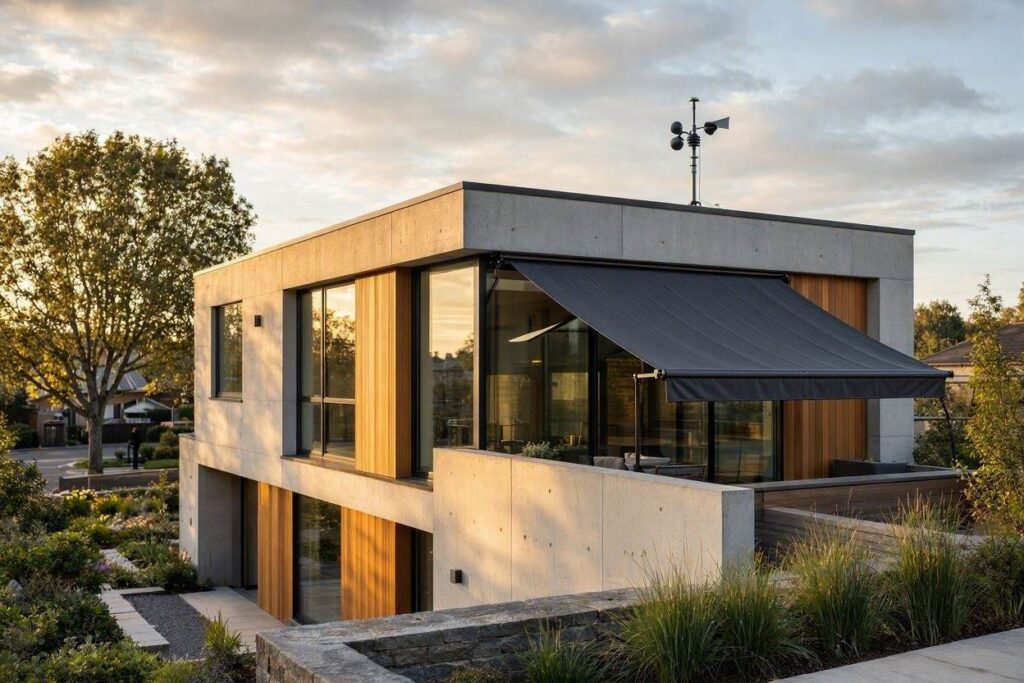
Spring and summer weather patterns have shifted dramatically. Sudden storms, unexpected wind gusts, and extreme temperature fluctuations are no longer rare anomalies—they are a daily reality that homeowners, villa owners, and commercial business operators must contend with regularly.
In this environment, a classic manual awning—operated by a hand crank and relying entirely on human vigilance—quickly transforms from a sun-shading asset into a direct threat to your wallet.
The scenario is all too familiar: you leave home in the morning under clear blue skies, an unforeseen gust of wind hits in the early afternoon, and you return to the unpleasant surprise of a torn fabric canvas, a bent articulated arm, or, in the worst-case scenarios, an anchoring system ripped clean off the wall.
When faced with such damage, the knee-jerk reaction is to call a specialist for repairs or component replacement. This is precisely where a financial paradox emerges—one that few calculate in advance: the cost of a single emergency repair almost always exceeds the investment required to automate the awning with a tubular motor and a wind sensor (anemometer).
Awning automation should not be viewed as a mere comfort feature or luxury residential add-on. It is an active protection system—an “invisible” investment that pays for itself by safeguarding the building structure, ensuring personal safety, and preserving the long-term value of the installation.
1. Anatomy of a Damage Event: What Happens When Wind Strikes a Manual Awning
To understand the true financial benefits of prevention, it is essential to analyze the mechanics of an awning and the physical forces at play when an unexpected gust hits.
An extended awning functions as an aerodynamic sail. When wind blows beneath the open fabric, it generates massive upward lift and torsional stress that transfer directly onto the articulated arms, mounting brackets, and wall anchors.
[Unexpected Wind] ➔ [Sail Effect on Fabric] ➔ [Stress on Arms] ➔ [Mechanical Failure / Wall Damage]
When an awning is left open without an automatic retraction system, multiple failure points can occur—each carrying a heavy price tag:
Fabric Tearing and Laceration
Shade fabrics (such as solution-dyed acrylic or PVC) are engineered to withstand UV rays and weather exposure, but they have definitive tensile limits. When wind creates air pockets under the canopy, the intense pressure exerted on the seams and roller attachment points causes irreversible tearing, fraying, and split seams.
Bending or Distortion of Aluminum Arms
Folding arms contain internal steel cables or drive chains kept under high tension by heavy-duty springs. The lateral torsion caused by wind forces the arm beyond its natural flex axis, bending the die-cast aluminum profiles, snapping internal cables, or stripping the central elbow joints.
Stripping the Manual Crank Mechanism
In manual systems, the gear reducer (the worm gear drive connected to the crank handle) is dimensioned to hold the weight of the awning under stable conditions. When strong winds violently shake the roller tube, dynamic forces shatter the internal brass or steel gears, permanently locking the system.
Structural Damage to Building Walls
This is the worst-case scenario, yet it happens frequently on external thermal insulation systems (EIFS) or aged masonry. The leverage exerted by extended arms under wind pressure can rip mounting plates and chemical anchors out of the wall, causing partial structural collapse and severe facade damage.
2. The Financial Breakdown: Emergency Repair Costs vs. Automation Value
Many property owners and business managers hesitate to automate their awnings because they perceive the motor and sensors as an unnecessary additional expense. A detailed cost breakdown proves the exact opposite.
Here is a direct comparison between the expenses of restoring a wind-damaged awning and the cost of installing a preventive VDS automation system.
| Expense Item | Emergency Repair (Post-Damage Intervention) | Preventive VDS Automation (Motor + Anemometer) |
| Technician Call-Out / Labor | Mandatory (often requires emergency rates to secure hanging parts). | Single fee during initial setup and installation. |
| Fabric Replacement | High cost (site measurement, custom tailoring, re-fitting). | $0 / €0 (fabric is permanently preserved by quick automatic retraction). |
| Arm & Hinge Replacement | Medium-to-high cost for individual or paired folding arms. | $0 / €0 (arms never experience critical structural load). |
| Mechanical Spare Parts (Gearbox/Crank) | Cost of materials + extensive labor to dismantle the roller tube. | Completely eliminated (the motor replaces the manual gearbox). |
| Wall & Masonry Restoration | Structural repair and masonry work in severe cases. | $0 / €0 (wall anchors remain completely intact). |
| Downtime and Inconvenience | Awning unusable for weeks awaiting replacement parts. | Uninterrupted, protected operation 365 days a year. |
The Mathematics of SavingsRemediating damage after the fact forces you to pay twice: first to dismantle and dispose of ruined components, and second to purchase replacement parts (or an entirely new awning) while paying emergency labor fees.
Conversely, retrofitting an existing awning or installing a factory-automated VDS system represents a fixed, predictable cost that safeguards your initial awning investment for years to come.
A single avoided wind-damage event, intercepted in time by the anemometer, is enough to fully cover the entire cost of the automation kit.
3. How VDS Awning Automation Works: Tubular Motors and Anemometers
The effectiveness of this protective shield relies on the seamless synergy between mechanical power and intelligent electronics. A VDS automated awning system consists of three core components working in total harmony:
1. The Tubular Motor
The power engine behind the motion is the tubular motor, housed directly inside the metal roller tube around which the fabric wraps.
VDS tubular motors for awnings are engineered to deliver:
- High Torque and Lifting Capacity: Capable of smoothly operating awnings of any dimension, from compact residential balcony units to massive commercial patio covers.
- Precision Limit Switches (Mechanical or Electronic): Ensure the awning always stops at the exact correct extension limit and seals perfectly inside the protective cassette when closed.
- Smooth Drive Motion: Consistent, gradual motion eliminates the jerks and sudden tugs typical of manual hand-cranking, significantly extending the lifespan of the fabric.
2. The Anemometer (Wind Sensor)
The anemometer is the system’s vigilant “guard.” It is an aerodynamic sensor equipped with rotating cups or an integrated 3D/vibration sensor mounted on the front lead rail that continuously measures wind speed and structural movement in real time.
When wind gusts exceed a pre-set safety threshold (e.g., 20 mph or 30 km/h), the anemometer instantly sends a high-priority signal to the motor’s control unit.
3. The Control Unit and Safety Override
The electronic control board processes the alert from the anemometer and executes an immediate safety maneuver: the motor fully retracts the awning in a matter of seconds.
Critical Safety Feature: When the anemometer detects wind speeds above the hazard threshold, the control unit overrides all manual wall switches and remote controls. The awning cannot be manually reopened until the wind subsides below the safety threshold for a set cooldown period. This eliminates human error and oversight entirely.
Key governing standards include:
- EN 13241-1: Specifies safety and performance requirements for commercial, industrial, and garage doors and gates.
- EN 12453: Outlines safety requirements for power-operated doors, focusing on protection against crushing, shearing, trapping, and impact hazards.
- EN 12445: Defines test methods used to verify compliance with force limits mandated by EN 12453.
4. Beyond the Wind: Sun Sensors, Rain Integration, and Smart Home Ecosystems
While the anemometer provides asset protection, pairing it with additional environmental sensors transforms your awning into an energy-efficiency engine for the entire building.
Sun Sensors (Ambient Photocells)
During peak summer, direct solar heat gain through windows forces air conditioning units to run at maximum capacity, driving energy bills through the roof.
Installing an ambient light sensor connected to your VDS motor enables the awning to extend automatically as soon as sunlight hits the facade. This delivers clear benefits:
- Indoor spaces stay shaded and naturally cooler.
- Air conditioning usage drops significantly, cutting cooling energy costs by up to 30%.
- Interior furnishings, hardwood floors, and rugs are protected from UV fading.
Rain Sensors
Many shade fabrics are not designed to hold heavy standing water. When torrential rain collects on an extended canopy, it forms water pockets weighing hundreds of pounds that bend the roller tube and permanently stretch the fabric. A rain sensor detects the first drops and triggers automatic retraction before water weight can compromise the structure.
Smart Home Ecosystems & Remote Control
Using modern radio-frequency controls and smart home integration modules, VDS awning automations can be operated directly from your smartphone app or via voice commands. You can check awning statuses remotely, set customized schedule routines, or create synchronized automation scenarios alongside rolling shutters and motorized blinds.
5. Commercial Value: Patios, Restaurants, Bars, and Hospitality (HoReCa)
While residential automation provides peace of mind, for commercial venues and hospitality operators (Hotels, Restaurants, Cafés), it is an indispensable tool for protecting business continuity and daily revenue.
Outdoor dining spaces, rooftop lounges, and commercial patios are major revenue drivers. However, an unexpected windstorm with guests seated outdoors can rapidly devolve into an operational and safety hazard:
- Customer Safety Risks: A snapping awning arm or detaching bracket poses severe injury risks to patrons, exposing the business to civil liability and legal claims.
- Operational Chaos: Tasking floor staff with manually cranking down three or four large commercial awnings during a sudden downpour distracts them from service and panics guests.
- Immediate Revenue Losses: An awning damaged during a peak weekend shift forces the closure of outdoor seating for days or weeks, sacrificing thousands in lost covers.
A dedicated VDS commercial automation system eliminates these vulnerabilities. Wind sensors detect incoming turbulence and automatically secure outdoor shade structures, allowing your staff to focus entirely on customer care and service.
6. Why Choose VDS Automazioni Technology for Your Awnings
VDS Automazioni is an Italian manufacturer with decades of expertise in engineering and producing complete automation systems for gates, barriers, bollards, garage doors, rolling shutters, awnings, skylights, and window actuators.
Choosing VDS technology for your awning automation means relying on Italian engineering excellence, manufacturing quality, and long-term mechanical reliability.
Key Advantages of VDS Solutions:
- Precision Mechanical Engineering: VDS tubular motors feature heavy-duty internal gearing designed to handle continuous duty cycles and extreme temperature ranges without power loss or overheating.
- Comprehensive Torque Range: Available in a wide selection of power ratings (Nm) to match everything from small residential window shades to large-scale commercial pergolas.
- Smart Electronics & Precise Calibration: VDS control units and wind sensors offer customizable sensitivity thresholds, enabling precise calibration based on local microclimates and building exposure.
- Seamless Retrofitting: VDS systems are designed for easy installation on new builds as well as retrofitting onto existing manual awnings, without requiring invasive structural modifications or masonry work.
- Certified Technician Support: VDS supports its global installation network with comprehensive technical documentation, guaranteed original spare parts, and dedicated factory support to ensure flawless installation.
7. The Retrofitting Process: How to Automate an Existing Manual Awning
A common misconception is that upgrading to an automated, wind-protected system requires replacing the entire awning assembly.
In reality, if your current aluminum frame and fabric are in good physical condition, a fast and cost-effective retrofit is all that is needed.
- Inspection and Assessment: The installer checks the folding arms, wall mounts, and fabric to verify structural integrity.
- Crank Gear Removal: The manual hand-crank gear mechanism and drop rod are disconnected and removed.
- Tubular Motor Integration: The compact VDS tubular motor is inserted directly inside the existing fabric roller tube, completely hidden from view to preserve original aesthetics.
- Wind Sensor Installation: The anemometer is installed on the nearby exterior wall or lead bar in an optimal position to capture wind flow accurately.
- Wiring and Calibration: Electrical connections are completed, open/close limit positions are programmed, and a simulated wind test is executed to verify immediate automatic retraction.
Through a quick, non-invasive service call, a traditional manual awning is upgraded into a smart, self-protecting asset.
8. Preventative Maintenance Guide for Long-Term ReliabilityWhile automatic wind protection is the single best insurance policy for your awnings, performing minor seasonal checks ensures peak performance year after year:
Spring Check-Up (Beginning of Season)
Before daily summer usage begins:
- Clean the Anemometer Cups: Ensure spiderwebs, dust, or debris are not preventing the wind cups from spinning freely.
- Execute a Safety Test: With the awning extended, manually spin the anemometer cups or trigger the sensor to verify that the control unit instantly initiates full retraction.
- Inspect the Fabric: Ensure no winter debris or leaves are trapped along the roller path.
Winterizing Procedures
During cold months when awnings remain rolled up inside their cassettes or protective hoods:
Control Unit Protection: Verify that external junction boxes and control enclosures remain sealed against water ingress.
Deactivate Sun Sensors (if installed): Prevents the awning from deploying automatically on bright but freezing days where snow or ice could overload the motor.
Conclusion: Choose Peace of Mind Before Damage Occurs
In both residential property management and commercial business operations, the difference between an unexpected expense and a smart upgrade comes down to proactive protection.
Relying on a manual awning while hoping to be home in time—or betting against unpredictable weather patterns—is a risky gamble that inevitably leads to torn fabric, bent frames, and costly repair bills.
Automating your awnings with VDS Automazioni tubular motors and wind protection sensors delivers the ultimate return on investment: total peace of mind.
Whether you are away at work, on vacation, or asleep during a nighttime summer storm, you can rest easy knowing that VDS technology is actively safeguarding your property, retracting your awnings at the first sign of danger, and preserving your investment for years to come.