



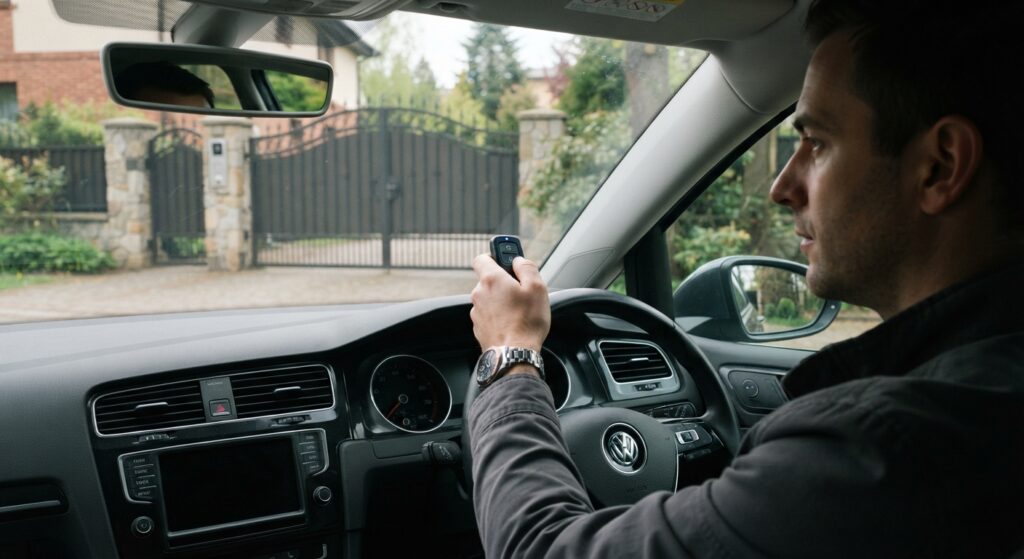
Murphy’s Law applied to home and industrial engineering features an unwritten yet infallible rule: an automated closing system will always choose the exact millisecond of maximum urgency to go on strike. Whether it is a company needing to open logistics gates at the crack of dawn, an apartment building with residents trapped in morning traffic, or a private villa where the delivery courier has just rung the bell and is threatening to leave, the outcome remains the same. The gate stops.
Behind these sudden lockups, however, there is almost never a cosmic misfortune or a catastrophic mechanical failure. Often, when analyzing the situation calmly, it turns out the cause lies in seemingly trivial details, unexpected environmental interactions, or minor daily oversights. In this technical and informative in-depth guide—designed for installers, public entities, and end customers—we will analyze the three most paradoxical yet extremely widespread reasons why an automatic gate decides to freeze at the worst possible moment, offering practical insights, immediate solutions, and an overview of how superior-quality components, such as those designed and manufactured entirely in Italy by VDS Automation, drastically reduce these headaches.
Before diving into the three scenarios, it is crucial to understand a key concept: a modern automation system for sliding or swing gates is a complex setup where precision electronics, mechanical kinematics, and safety sensors constantly communicate. When any of these elements experiences external interference, the control panel intervenes by stopping the maneuver to preserve the motor’s integrity and, above all, people’s safety.
1. The Vengeance of Nature and the Micro-Habitat: When the Photocell is “Clandestinely” Occupied
The first reason, as frustrating as it is bizarre, concerns the safety device par excellence: photocells. These infrared devices emit an invisible beam that crosses the passageway. If the beam is interrupted, the control unit receives an order to immediately stop or reverse the gate leaf’s motion to prevent crushing people, animals, or vehicles.
The paradox arises when interrupting this beam is not a “structural” obstacle, but rather an uninvited tenant of the garden’s microcosm.
The Dynamics of the Invisible Block
During warmer months or seasonal transitions, surrounding vegetation explodes into lush growth. Thin branches, unruly creepers, or tall clumps of grass can sway under a light gust of breeze, intersecting the line of sight between the transmitter and receiver photocell precisely when the gate is triggered. Even more frequent is the phenomenon linked to local wildlife: spiders weaving geometric webs directly on the photocell lens, or small insects attracted by warmth or residual light choosing the device’s casing as a temporary home.
The visual result is disorienting: you press the remote control, the flashing light activates signaling that the command was received, but the gate remains motionless or gives a small twitch and goes back. The average user immediately suspects an electronic board failure or a burned-out motor, triggering a sequence of frantic button-mashing.
Technical Analysis and Prevention
From a system standpoint, photocells are tested to tolerate a certain percentage of surface dirt, but a thick cobweb or an insect resting millimetrically on the receiving diode completely obscures the infrared signal. The control unit interprets this situation as a permanent obstacle in the gateway.
- Visual Check: The first check to perform in case of an anomalous lockup without signs of mechanical stress is inspecting the photocell optics. Often, a wipe with a microfiber cloth or removing a spiderweb solves the problem instantly.
- Greenery Maintenance: Installers and maintenance personnel always recommend keeping a clearance zone free of bushes or flower pots within a radius of at least thirty centimeters around the photocell posts.
- The Reliability of VDS Systems: The safety solutions offered by VDS Automation integrate advanced filters and stabilized optics to minimize false triggers caused by marginal environmental interference, while ensuring maximum compliance with current European safety regulations for access points.
2. The Mystery of the “Zombie” Remote Control and the Phantom Battery Saga
The second scenario takes us straight into the field of behavioral psychology applied to everyday technology. The gate remote control is the most abused object in our routine: we toss it onto keychains with heavy keys, leave it exposed to scorching sun on the car dashboard, drop it on asphalt, and, in worst-case scenarios, accidentally wash it in the washing machine inside our pants pockets.
Despite this, it keeps working faithfully for years… until the day we decide to put it to the test during a time crunch.
The Energy Decay Curve and Human Reactions
The lithium or alkaline batteries in remote controls do not die all at once; they undergo a slow and inexorable voltage drop. The transmitter’s integrated circuit continues to emit a radio signal, but with a field strength so low that the gate control unit’s antenna can no longer decode it if you are more than a meter away.
The average user’s reaction to this phenomenon is scientifically fascinating and unfolds in four phases:
- The Vigorous Press: Convinced that pressing the button with superhuman physical force can compensate for the lack of electrons, your knuckles turn white.
- Vehicular Contortions: You start pointing the remote upward (toward the sun visor), downward (toward the gearshift), or out the window as if searching for signal with a satellite phone in the desert.
- The “Percussion Battery” Effect: You violently tap the back of the remote against the palm of your hand or the steering wheel, hoping for a miracle of internal chemical recombination.
- Resignation and Use of the Mechanical Key: The realization that by getting an inch closer to the antenna or changing the battery, the gate happily springs back to life as if nothing happened.
Radio Standards in Modern Automation
To prevent reception issues, modern transmission systems utilize stable frequencies (such as 433 MHz or 868 MHz) with ultra-secure Rolling Code encodings that prevent signal cloning. However, remote control quality makes all the difference: robust transmitters with top-tier internal components maintain emission efficiency even when battery charge drops below critical thresholds, warning the user with slight flickers of the integrated LED before total blackout.
3. The Grand Classic: The Emergency Release Key Forgotten After a Blackout
Here we arrive at the undisputed king of false faults, the one that brings a bitter smile to specialized technicians called out for urgent after-hours service: the trap of the manual release mechanism.
The Genesis of the Problem
Imagine the scene: last week there was a severe summer thunderstorm. The public electrical grid suffered a surge and the power went out. The automatic gate (whether sliding or swing) stopped responding to any radio commands. In the panic of having to leave home for work, you remembered the instructions given at the time of installation: take the triangular or customized key provided, insert it into the gearmotor’s designated lock cylinder, turn it, and pull the release lever to disengage the mechanical clutch.
The operation succeeds perfectly: the gate can be pushed open by hand with a single finger, you drive out, close it as best you can, and leave.
The Bitter Awakening
The problem arises when electricity returns, life resumes its normal course, and you completely forget about having uncoupled the mechanism. The next scene features the driver arriving in front of the gate, confidently pressing the remote, hearing the control unit relay click, seeing the flashing light illuminate… and watching the total immobility of the gate leaf, which mockingly lets itself drift lazily in the breeze like a saloon door in the Wild West.
The typical mistake consists of blaming a fried board, a motor blown by lightning, or an irreversible software lock.
How Industrial Design Steps In
From the perspective of safety and ease of use, high-end gearmotors—including those developed in the VDS Automation catalog—place meticulous attention on designing the release assembly. Levers must be protected by anti-tamper casings yet easily accessible in case of a true emergency, and mechanical reset systems must clearly indicate the disengaged state.
Furthermore, in more advanced condominium or industrial settings, release systems can be integrated with auxiliary safety contacts that signal to the control unit (or a home automation supervision system) whether the motor is in manual mode, preventing erroneous startups and reducing unwarranted service calls to zero.
Beyond the Gate: The Universe of VDS Automations for Integrated Security and Comfort
If we have focused so far on automatic gates, daily experience in residential, commercial, and industrial sectors reminds us that the concept of an “intelligent entrance” embraces an immense variety of doors and portals. VDS Automation, backed by its manufacturing philosophy entirely localized in Italy, is not limited to sliding and swing gate automation; it covers a complete technological spectrum designed to meet the demands of public entities, professional installers, and discerning end customers.
Let’s explore how this same philosophy of reliability and mechanical robustness extends to other automation devices populating modern buildings.
| Automation Type | Main Application | Key Advantages of the VDS Range |
| Road Barriers | Corporate parking lots, condominium areas, highway tollbooths. | High maneuver speed, intensive duty cycles, wind-reinforced booms, and electronic slow-down systems. |
| Road Bollards | Pedestrian zones, ZTL (limited traffic zones), perimeter protection of sensitive buildings. | Total-retractable hydraulic bollards, high impact resistance, anti-terrorism certified versions, and LED night visibility. |
| Roller Shutters and Awnings | Residential, offices, commercial buildings. | Silent tubular motors, high-precision mechanical or electronic limit switches, and integration with sun/wind weather sensors. |
| Skylights, Domes, and Windows | Industrial buildings, schools, shopping malls, condominiums. | Chain or rigid-stem actuators for natural ventilation and smoke/heat exhaust ventilation (RWA) systems. |
| Garage Doors | Residential garages, underground parking facilities. | Sectional and up-and-over door gearmotors with quick release, ultra-silent belt or chain traction, and break-in protection systems. |
The Strategic Choice for Installers and Public Entities: Why Rely on a Made in Italy Manufacturer
For a professional installer or a public entity planning extraordinary maintenance and the installation of new automated gates, choosing a technological partner is critical. Opting for imported components without traceability or lacking direct local technical support can turn a minor job into a logistical nightmare of unfindable spare parts and unacceptable downtime.
VDS Automation represents a solid benchmark in the manufacturing landscape thanks to well-defined corporate pillars:
- Control of the Production Chain: Every single gear, electric motor, and control board is machined and assembled inside Italian facilities, ensuring rigorous quality standards and structural resistance superior to market averages.
- Immediate Spare Parts Availability: Unlike extra-European import products, a short supply chain guarantees installers constant availability of any replacement component, reducing equipment downtime.
- Dedicated Technical Support: A team of specialized engineers and technicians supports professionals daily through design, wiring, and complex troubleshooting for special or high-traffic systems.
Conclusions: The Value of Preventive Maintenance and Build Quality
Sudden automatic gate lockouts—caused by a photocell blocked by a busy spider, a remote control with a dead battery, or forgetting the emergency release lever—teach us that the most advanced technology still requires a minimum of awareness and care in daily management.
Investing in automation systems designed to last over time—whether it’s a residential gate, a road barrier for a commercial parking lot, or an opening system for industrial windows and skylights—means eliminating the risk of unpleasant surprises from the root. Choosing the reliability of the VDS Automation range means relying on decades of Italian engineering experience, where mechanical robustness and electronic innovation work in perfect synergy to simplify everyday life.