



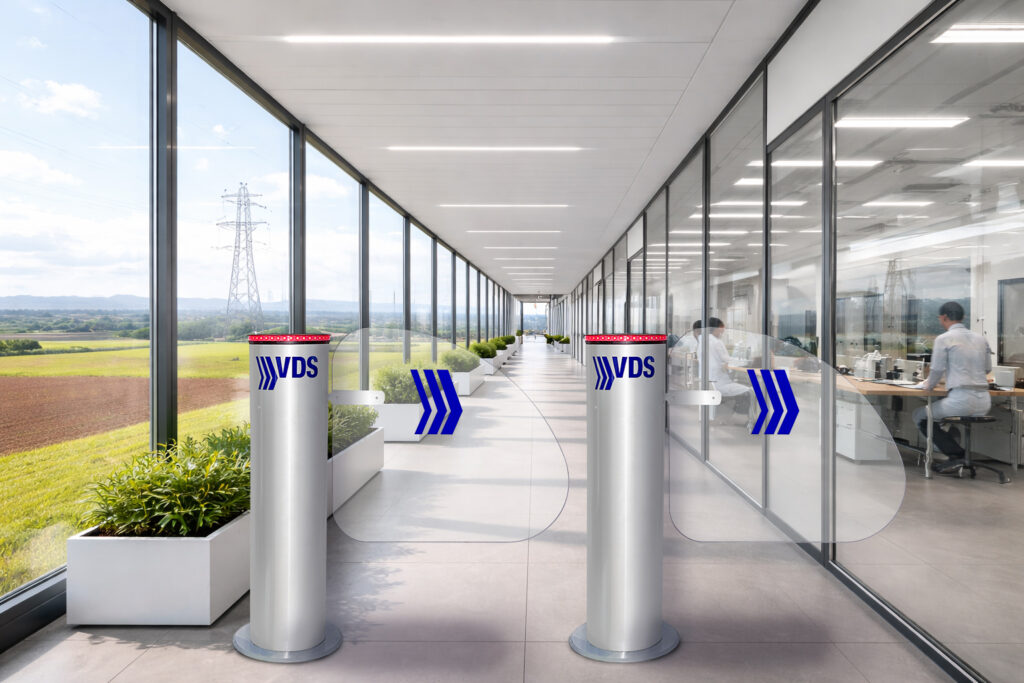
In the landscape of modern security, automatic turnstiles are no longer just physical barriers. They now represent the crucial intersection between traditional physical security and data management in IT. For facility managers at large companies, IT/security managers, and design firms, understanding how to integrate an automatic turnstile with advanced access control systems is no longer optional—it’s a strategic necessity.
The Automatic Turnstile: More Than a Gate
A modern automatic turnstile isn’t just a mechanism regulating people flow. It’s an intelligent device that communicates in real-time with the company’s security systems, logs every access, and generates valuable data for regulatory compliance and operations management.
High-quality turnstiles are designed for offices and companies needing sophisticated access control. With fast opening times (2-3 seconds) and compact design, they ensure smooth passage while upholding high security standards. What truly makes them innovative is their ability to interface with various authentication technologies: from traditional RFID badge readers to advanced biometrics and mobile smartphone credentials.
Authentication Technologies: RFID, Digital Badges, and Biometrics
Companies today have several options for authenticating users at turnstiles, each with specific pros and cons.
RFID and Traditional Badges
RFID badges remain a reliable, established solution. They allow contactless reading (up to about 30 cm) and integrate easily with existing legacy systems. The main advantage? Backward compatibility and low costs. The downside? Badges can be lost, cloned, or lent to unauthorized colleagues.
Biometric Authentication
Fingerprint, facial recognition, iris scanning—these eliminate falsification risks entirely. An unauthorized person can’t use a colleague’s fingerprint. However, they require more sophisticated hardware and an initial enrollment phase.
Mobile Credentials on Smartphones
These represent the future of access control. Using NFC (Near Field Communication) or short-range Bluetooth (up to 10 meters), employees use their smartphone as an access key. No badge to forget at home, no card to renew. The phone itself is protected by PIN and biometrics for dual authentication. Plus, mobile credentials can be revoked instantly without physically retrieving a badge.
Premium modern turnstiles support multiple technologies simultaneously. Companies can gradually migrate from traditional badges to biometrics or mobile without replacing the entire system.
Cybersecurity: Encryption as the Foundation
When an employee presents their badge at the turnstile, something complex happens behind the scenes. Authentication data travels from the reader to the turnstile’s control panel, then to the central server, and finally gets logged in access records. At every point in this path, the data is vulnerable.
Encryption in Transit
Data transmitted between the reader and the central system must be protected. The market standard is TLS (Transport Layer Security), which safeguards information as it travels across the network. For mobile credentials, it’s even more critical: Bluetooth and NFC communications must use end-to-end encryption. Best practice involves AES-256, an encryption standard that would require a supercomputer trillions of years to compromise.
Next, verify alignment between the transmitter and receiver. Even a minimal shift can disrupt the beam and trigger the safety lock. Use a level or other precision tools to ensure components are perfectly aligned. If photocells are physically damaged, they require replacement.
Encryption at Rest
Even when access data is stored on the company’s servers, it must remain protected. If a hacker breaches the database, they would find only incomprehensible code strings, not usable credentials.
A professional access control system ensures this protection through certified AES-256 standards.
GDPR and Personal Data Management: The Facility Manager’s Challenge
Here we address the core issue: every time an employee passes through the turnstile, the system records personal data – the fact that that person was in that building at that specific time. In Europe, this data is covered by the GDPR (General Data Protection Regulation).
The GDPR imposes three fundamental principles:
1. Minimizzazione dei dati
Collect only the data you actually need. There’s no need to record the person’s photo, walking speed, or other overly invasive information. It’s enough to know that authorized person X entered at 08:30 and exited at 17:45.
2. Consent and Transparency
Employees must know their movements are tracked. They need clear communication about the purpose (security), legal basis (company’s legitimate interest), and data retention period.
3. Right to be Forgotten
If an employee ends their relationship with the company, their access data must be deleted within a reasonable timeframe (often 30-90 days). A well-designed system must allow these deletions automatically.
A turnstile system connected to professional access management software enables exactly this: automatic audits, scheduled data deletion, and reports to prove compliance during inspections.
Zero Trust: The Modern Security Paradigm
Modern cybersecurity has abandoned the “trusted perimeter” concept (trust everything inside the network). Today, the Zero Trust principle reigns: trust no one, not even internal employees, unless they pass required checks.
How does this apply to the turnstile? In several ways:
Continuous Authentication
A valid badge at entry isn’t enough. The system should continuously verify that the device using it is still authorized.
Least Privilege Access
An employee in the admin office shouldn’t access the server room. The turnstile should check not only the person’s identity but also whether that specific person has rights to that specific area at that time.
Micro-Segmentation
The company isn’t one area but a network of zones. Each zone has its turnstile and rules. A stolen patent, compromised USB key, or malware shouldn’t grant access to all company areas.
A modern turnstile integrated into centralized management platforms facilitates implementing all these policies.
Anti-Tailgating: Where Physical Security Meets Cybersecurity
An often underestimated issue is “tailgating” – when an unauthorized person enters by piggybacking on an authorized colleague’s passage. A traditional turnstile allows one person per credential, but how does it recognize that?
High-quality turnstiles use infrared sensors and millisecond motor control to allow exactly one passage per valid credential. If a second person tries to enter in the same opening cycle, dedicated sensors detect it and trigger the alarm.
From a cybersecurity perspective, every tailgating attempt is logged: date, time, video frame if available. Data flows to the central system, where machine learning algorithms can identify suspicious behavior patterns. An employee repeatedly attempting tailgating can be intercepted, investigated, and disciplined.
Integration with Enterprise Systems: Simplified Management
One major challenge for facility managers is integrating the turnstile with myriad existing systems: time-tracking software, telephony systems, identity management platforms (Okta, Azure AD), visitor control software.
Modern turnstiles communicate with these via open standards (REST APIs, LDAP) and established interfaces (dry contact, Ethernet PoE). This means:
- · When a new employee joins, their profile is created in the HR system and automatically synced to the turnstile. On day one, their badge works without manual intervention.
- · When an employee is promoted and gains access to new areas, the manager approves the request in a single portal, and the turnstile updates in real time.
- · When an employee leaves, access revocation happens with one command. No risk of a deactivated badge still working on other systems.
This automation reduces human errors and speeds processes – critical for compliance with standards like SOC 2 or ISO 27001.
Real-Time Monitoring and Reporting
An often overlooked aspect is the value of data generated by the turnstile. Every passage is an analyzable event.
A facility manager can create dashboards showing:
- · Usage Metrics: What time do employees arrive and leave? Which areas are crowded? Where to expand space?
- · Security Anomalies: An employee accessing at 3 AM alone? A visitor staying longer than expected? Repeated tailgating attempts?
- · Regulatory Compliance: Automatic reports proving to auditors that only authorized personnel accessed sensitive areas.
Professional turnstiles integrated into access management platforms generate this data automatically, reducing admin workload and increasing security transparency.
Conclusions
In conclusion, the modern automatic turnstile isn’t an isolated security tool. It’s the central node of a physical and cybersecurity ecosystem that, if well-designed, protects the company on multiple fronts: prevents unauthorized access, ensures regulatory compliance, reduces operational costs via automation, and provides valuable data for continuous improvement.
For facility managers seeking a reliable, scalable solution, VDS Automazioni’s RIKI-20 represents a mature choice. It not only guarantees physical access control with anti-tailgating technology and multi-authentication compatibility but integrates seamlessly into enterprise IT ecosystems, enabling truly modern access control – secure, compliant, and data-rich. The RIKI-20 features advanced safety sensors, supports API integrations, and offers fast response times for a smooth user experience while maintaining high protection standards.
Investing in an advanced access control system isn’t an expense – it’s strategic protection for the company’s information and physical assets.