



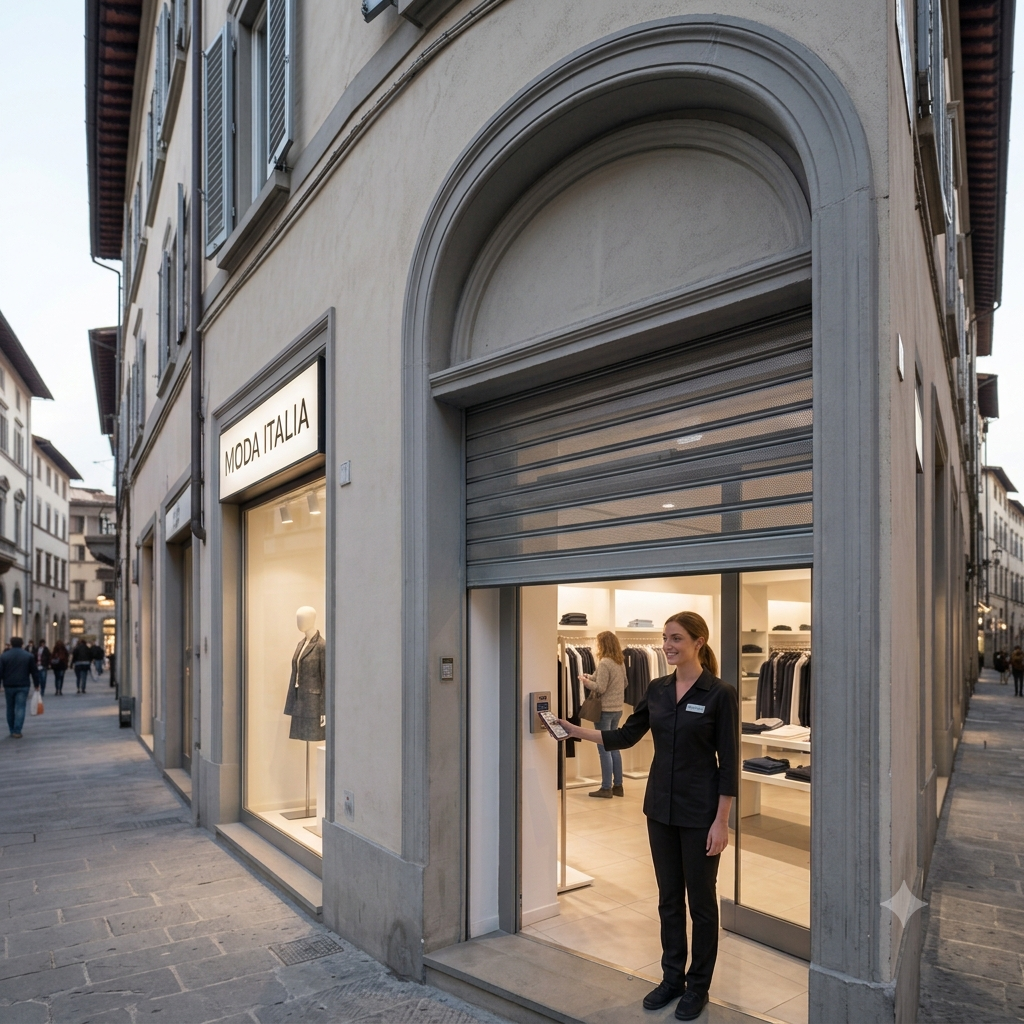
Managing a commercial business means constantly balancing profitability, operational efficiency, staff welfare, and asset protection. Among the structural elements that impact a shop’s daily routine, rolling shutters play a primary role. Too often considered simple passive barriers, shutters represent both the first line of defense against break-ins and the first physical operation performed by staff during opening and closing hours.
Technological advancements have transformed these closures from purely mechanical components into integrated automatic systems. Adopting motorized solutions for commercial shutters addresses specific demands: countering crime through advanced mechanical and electronic devices, preventing workplace injuries and musculoskeletal disorders among employees, and preparing retail store infrastructure for the challenges of commercial building automation.
1. Anti-Crime Security and Protecting the Commercial Envelope
Storefront windows are the main driver for attracting customers, yet they also constitute an building’s most vulnerable access point. During off-hours, forced entry and opportunistic break-in attempts can cause direct financial damage (stolen merchandise) and indirect costs (business interruption, structural repair).
Automatic Locking Mechanisms and Anti-Lifting Features
Manual shutter operation relies heavily on key-operated locks placed on the bottom slat (the “terminal”). These systems suffer from structural vulnerabilities related to load distribution: by applying leverage or bending the sheet metal, intruders can often partially lift the shutter and force the anchoring points.
Installing a central-axle electromechanical motor or a direct-drive gear system transforms the shutter’s entire kinematics:
- Gearbox Irreversibility: VDS shutter motors feature mechanical gearboxes designed to prevent the reverse rotation of the shaft when unpowered. Without an electrical command, the winding axle remains mechanically locked, making manual lifting attempts from the outside ineffective.
- Uniform Retention Force: Unlike single-point manual locks, a motorized axle exerts traction and holding force across the entire width of the shutter curtain, reducing structural flex.
Coded Emergency Release Systems: Power outage management is handled via high-resistance steel release cables located inside the building or protected by external key-coded security boxes accessible exclusively to authorized personnel
Mitigating Ram-Raid Risks
Forced entry attempts using vehicles (“ram-raiding”) aim to bend the curtain or dislodge the slats from the side guide channels. While impact resistance depends on metal gauge and slat design (micro-perforated, solid, or tubular mesh), a VDS automated system increases overall assembly rigidity:
- Constant Tension on the Shaft: The motor maintains mechanical pre-tension on the winding axle, eliminating slack that would otherwise allow slats to pop out of side tracks during a impact.
- Integration with Motorized Deadbolts: Automated systems interface seamlessly with electric side locks and motor-driven deadbolts that automatically engage into the masonry structure whenever the shutter reaches its lower limit switch.
Interfacing with Alarms, Video Surveillance, and Access Control
VDS shutter automation operates as a core component of the building’s broader security ecosystem. Modern electronic control units feature dry-contact auxiliary inputs/outputs and communication buses designed to connect with intruder alarms and home automation systems.
Status Verification: Using magnetic limit switches or micro-switches inside the motor assembly, the security panel receives immediate confirmation of complete shutter closure before arming volumetric sensors.
Deterrence Scenarios: If tamper sensors detect unauthorized movement or impacts on the shutter, the control unit can initiate forced closure, notify a central monitoring station, or trigger alarm sirens and floodlights.
Access Audit Trails: Motorized shutter operation replaces duplicate physical keys with managed credentials (RFID badges, temporary PIN codes, smartphone digital keys). This gives security managers a clear audit trail of opening and closing events.
2. Ergonomics, Employee Health, and Occupational Safety Compliance
Manual load handling is a leading cause of workplace injuries and musculoskeletal disorders (MSDs) in the retail and wholesale sectors. Opening a medium-to-large commercial shutter requires lifting forces ranging from 40 kg to over 150 kg, often unevenly distributed due to worn counterbalancing springs.
Biomechanical Hazards of Manual Shutter Operation
Operating a manual rolling shutter forces workers into high-risk postures:
- Deep Forward Trunk Flexion: The initial lift starts at floor level, forcing the operator to bend the spine beyond safe physiological limits.
- Overhead Extension: Reaching the top of the travel path requires pushing the shutter above shoulder height, overloading the glenohumeral joint and the cervical-thoracic spine.
- Downward Traction: Closing the shutter often requires jumping or pulling down on a strap using full body weight, exposing staff to sudden impact forces or muscle tears if the mechanism jams or releases unexpectedly.
Repetitive daily execution of these movements leads to chronic conditions such as herniated discs, acute lower back pain, rotator cuff tendinitis, and nerve compression syndromes.
Preventing Accidents from Mechanical Failures
Manual shutters rely on pre-tensioned spring boxes to balance curtain weight. Over time, metal fatigue causes springs to lose tension or break unexpectedly.
- Uncontrolled Falling: A broken spring on a manual shutter causes the curtain to collapse rapidly under gravity, posing a severe crushing hazard to anyone standing in the doorway.
- Integrated Safety Brakes (Parachute Valves): VDS automation systems incorporate anti-fall safety brakes. If a spring or drive component fails, the mechanical safety brake engages instantly, stopping the curtain’s fall within centimeters and preventing severe injuries.
3. European Safety Standards & Regulatory Compliance
Automating a commercial shutter transforms it from a simple physical barrier into a power-operated machinery assembly. Consequently, the system must be designed, installed, and maintained in compliance with European Machinery Directives and harmonized technical standards.
Construction Products Regulation (CPR) and Machinery Directive
Power-operated commercial shutters fall within the scope of Machinery Directive 2006/42/EC and EU Regulation 305/2011 (CPR). The entire assembly—comprising the curtain, guide tracks, drive motor, and control unit—must bear CE marking and be delivered with a Declaration of Performance (DoP).
Key governing standards include:
- EN 13241-1: Specifies safety and performance requirements for commercial, industrial, and garage doors and gates.
- EN 12453: Outlines safety requirements for power-operated doors, focusing on protection against crushing, shearing, trapping, and impact hazards.
- EN 12445: Defines test methods used to verify compliance with force limits mandated by EN 12453.
Active and Passive Safety Features in VDS Systems
To safeguard pedestrians, vehicles, and goods passing beneath an automated shutter, VDS control panels process real-time inputs from several safety devices:
1. Impact Force Limitation
VDS motor drives and control units incorporate torque monitoring systems or electronic encoders. If the shutter encounters an obstruction while closing, the system detects a spike in current draw or a drop in angular speed, instantly reversing direction before impact forces exceed allowable thresholds.
2. Sensitive Safety Edges
Fitted along the bottom rail of the shutter, safety edges can be resistive (8.2 kΩ) or optical. When the bottom rubber seal deforms upon contact with an object or person, a signal is transmitted—via spiral cable or wireless link—to the control unit, halting downward travel immediately.
3. Safety Photocells
Mounted on inside or outside wall surfaces at standardized heights, infrared photocells project an invisible light beam across the threshold. Interrupting this beam during closure stops or reverses the shutter, preventing physical contact entirely.
| Safety Device | Primary Function | Standard Reference | Retail Operational Benefit |
| Torque Limiter / Encoder | Monitors motor load; reverses travel on contact | EN 12453 | Prevents damage to items left under the shutter |
| Safety Edge (8.2 kΩ) | Detects contact on bottom edge of shutter | EN 12978 | Active protection for staff and pedestrians |
| Infrared Photocells | Non-contact obstacle detection across threshold | EN 12453 | Avoids collisions with inventory carts and trolleys |
| Anti-Fall Safety Brake | Locks axle if mechanical failure occurs | EN 12604 | Ensures physical safety during spring breakages |
| Key Selector / Keypad | Secure access control for operating shutter | EN 12453 | Prevents unauthorized operation |
4. Operational Efficiency, Energy Savings, and Smart Store Integration
In modern retail environments, shutter automation is more than a safety asset; it plays a active role in streamlining daily operations. Automated schedules and centralized controls save work hours, maintain internal indoor climates, and reduce energy costs.
Streamlined Workflows and Saved Time
Retail facilities with multiple access points (such as shopping malls, department stores, or auto dealerships) spend considerable time manually opening and closing 10 to 20 individual shutters every shift change.
VDS centralized control systems streamline this process:
- Centralized Opening/Closing: A single input from a master switch, touch screen, or mobile device triggers simultaneous or staggered operation for all varchi (access points).
- Zoned Grouping: Operations managers can open warehouse loading bay shutters at 7:00 AM while keeping sales floor shutters secured until public opening hours at 8:30 AM.
- Elimination of Downtime: Employees can focus on value-added tasks—such as stocking shelves, updating displays, or prepping cash registers—instead of spending time on manual physical tasks.
Climate Control and Energy Optimization
Uncontrolled open doorways accelerate heat exchange, placing excessive loads on heating, ventilation, and air conditioning (HVAC) systems.
Automated micro-perforated or solid shutters linked to environmental sensors or timers help regulate energy consumption:
- Automated Solar Shading: During midday summer heat, shutters can automatically drop to a pre-set height to block direct sunlight, lowering air conditioning load and protecting light-sensitive inventory in display windows.
- Overnight Thermal Envelope: Combined with high-efficiency glass store fronts, closing automated shutters at night adds an extra insulating air gap, reducing heat loss during cold winter months.
Smart Building and IoT Connectivity
VDS commercial control units interface with major Building Management Systems (BMS) and IoT protocols (such as KNX, Modbus, Wi-Fi, and Z-Wave)
This integration enables advanced operational scenarios:
Remote Supplier Access: Deliveries outside normal hours can be managed remotely by raising a stockroom shutter for a verified courier while monitoring via security cameras.
Automated Routines: Single-touch “Morning Opening” sequences disarm internal security zones, open shutters to 100%, activate store lighting, and unlock sliding entrance doors automatically.
Real-Time Status Monitoring: Store owners can verify via smartphone app whether all shutters across a multi-location store network are fully closed and locked at the end of the day.
5. VDS Automazioni Hardware Solutions for Commercial Shutters
Central-Axle Gear Motors
Central-axle drives are the standard choice for automating traditional rolling shutters mounted on shafts with counterbalancing spring boxes.
1. Single-Motor Models
Designed for small-to-medium shutters (up to 150–180 kg total curtain weight). Built with die-cast aluminum housings, high-strength alloy gears, and permanent synthetic lubrication to minimize maintenance requirements over their service life.
2. Dual-Motor Models
Engineered for wide commercial openings and heavy-duty industrial shutters (up to 300–360 kg). The dual-motor layout provides high starting torque and balanced drive force along the axle, preventing curtain twisting and track binding.
- Electromechanical Braking: Available in both reversible (requiring manual lock sets) and irreversible configurations with integrated electromechanical brakes. The brake locks the axle movement the moment power is cut, delivering high mechanical resistance against upward force.
- Axle Adaptability: VDS modular components accommodate 60 mm or 48 mm shaft diameters and 200 mm or 220 mm spring boxes using glass-reinforced nylon adapter sleeves.
Tubular Motors for Compact Assemblies and Open-Mesh Grilles
In historical districts or high-end malls with strict architectural guidelines, space for winding drums is often limited. These applications rely on compact roller shutters powered by tubular motors installed directly inside the winding tube.
- Space-Saving Footprint: Available in various diameters (from 45 mm up to 92 mm for heavy-duty requirements), these motors minimize head-room requirements and clean up storefront sightlines.
- Precise Limit Setting: Equipped with mechanical or magnetic electronic limit switches, these units ensure precise stopping points at top and bottom travel limits, protecting individual slats from impact damage.
- Quiet Operation: Integrated planetary gearboxes deliver ultra-quiet travel, making them well-suited for luxury boutiques and indoor commercial arcades.
Electronic Control Panels and Remote Access
VDS mechanical drives are managed by sophisticated electronic control systems:
6. Italian Manufacturing Quality and Technical Support Network
When selecting door automation components, raw material quality and precision machining dictate the difference between a durable system and one prone to frequent breakdowns.
The Value of Italian Engineering
VDS Automazioni designs, machines, and assembles its automation systems in Italy. In-house control of the manufacturing chain delivers key operational advantages:
- High-Grade Materials: High-strength alloy steel, bronze worm gears, and die-cast aluminum frames ensure reliable operation under thermal and mechanical strain. VDS drives are rated for outdoor operating temperatures from -20°C to +55°C.
- Comprehensive Quality Testing: Every drive unit undergoing production is tested under dynamic load conditions for current draw, brake holding power, and electrical insulation, reducing out-of-box failures.
- Long-Term Component Availability: Unlike disposable imported drives, VDS maintains long-term spare parts availability and ensures backward compatibility between new control electronics and older installed mechanical bases.
The Role of Professional Installation
System safety and performance depend as much on proper installation as they do on motor quality. VDS supports its products through a network of certified technicians and system integrators.
Certified installers perform thorough commissioning procedures:
- Structural Pre-Check: Evaluating shaft straightness, spring tension balance, guide alignment, and bearing wear before mounting the motor drive.
- Precision Mounting & Wiring: Executing mechanical anchoring and wiring to electrical codes, setting active safety devices to optimal sensitivity.
- Force Measurement & Certification: Measuring closure impact forces with calibrated load-cell instruments per EN 12445 standards, adjusting torque limiters and encoder curves accordingly.
- Documentation Delivery: Providing the site owner with a complete Technical File, including the CE Declaration of Conformity, User Operating Manual, Emergency Manual Release Guide, and Maintenance Logbook.
The Primacy Effect in Modern Hospitality
In hospitality marketing, cognitive psychology has extensively documented the weight of the Primacy Effect: the initial information and sensory inputs an individual processes form the cognitive framework through which all subsequent experiences are evaluated.
If the guest’s first physical interaction with the hotel causes frustration, uncertainty, or a feeling of abandonment:
- The guest will judge subsequent minor imperfections (a brief delay during check-in or a room not quite ready) with significantly higher severity.
- The Perceived Value of the daily room rate drops instantly.
- The guest’s confidence in the overall safety and security of the property is compromised.
Clinical Definition of “Intercom Syndrome”: The collection of psychological micro-stresses experienced by guests who, after a long journey, find themselves blocked outside a property, unable to gain access in a smooth, autonomous, and elegant manner.
From Physical Gate to Brand Perception
A monumental wrought-iron gate or a minimalist modern barrier loses all its architectural charm if driven by grinding, slow, or thermal-clogged motors during peak arrival hours. Automation is not a mere mechanical construction component: it is the operational extension of the hotel’s hospitality philosophy.
Integrating high-performance, silent, and aesthetically refined automation systems establishes the hotel’s positioning as a modern, secure, and guest-centric establishment from the very first meter.
- Anatomy of Critical Access Points in Hospitality Properties
Eliminating the Intercom Syndrome requires systematically mapping all vehicular and pedestrian access points across the property.
- The Main Vehicular Gate (Swing or Sliding Gates)
As the primary gateway to the estate, typical issues encountered in legacy hotel gates include:
- Inadequate Operating Speed: Wait times exceeding 15–20 seconds create tailbacks on public roads and agitate arriving guests.
- Incorrect Motor Sizing: Standard residential-grade motors fitted on heavy hotel gates overheat during summer peak seasons under continuous use.
- Obtrusive Aesthetics: Bulky, unsightly mechanical arms that mar the architectural design of the gate.
- Parking Area & Flow Management (Traffic Barriers & Bollards)
Whether in luxury resorts, historic city-center boutique hotels, or high-traffic business hubs, parking access requires clear segregation between:
- Exclusive access reserved for staying guests and VIPs.
- Dedicated lanes for suppliers, staff, and logistical services.
- Pedestrianized or restricted traffic zones (ZTL) within hotel grounds.
Deploying high-speed automatic traffic barriers or retractable hydraulic bollards allows properties to secure perimeter boundaries without erecting harsh visual walls, preserving the elegance of the surrounding landscape.
- Underground Garages & Sectional Doors
Covered parking facilities serve as another touchpoint for quality perception:
- Acoustic Isolation: Garage door motors (for overhead or sectional doors) must not transmit vibrations or structural noise to guest rooms situated on upper floors.
- Continuous Duty Operations: A garage door for a 100-room hotel completes hundreds of opening/closing cycles daily. Non-continuous duty motors inevitably fail under high demand.
VDS Automazioni Solutions for High-End Hospitality
VDS Automazioni, an Italian company with decades of specialization in entrance automation engineering, delivers a complete suite of solutions tailored for the hospitality sector, manufactured to strict Made in Italy engineering standards.
- Swing and Sliding Gate Automations: Power, Smoothness, and Silence
To eliminate arrival delays, VDS engineers drive systems with high torque, precision mechanics, and advanced electronic control units.
- Sliding Gate Systems: Engineered to move gates of all sizes and weights (from lightweight aluminum frames to multi-ton industrial or historic structures). Equipped with encoder-based control units for millimeter-precise deceleration during opening and closing, ensuring smooth, judder-free motion.
- Swing Gate Systems (Electromechanical Arms, Hydraulic Rams, Underground Actuators):
- Underground Solutions: Perfect for historic estates, boutique hotels, and architecturally protected properties. The drive system is completely concealed beneath ground level, leaving the natural beauty of the gate untouched.
- Hydraulic Systems: The ultimate choice for heavy-duty gates requiring high hourly cycle rates. Hydraulic fluid guarantees heat dissipation, zero premature mechanical wear, and whisper-quiet operation.
High-Speed Barriers and Security Bollards
Dynamic parking management demands rapid performance:
Product Type | Typical Hotel Application | VDS Key Technical Advantage |
Automatic Barriers | Guest parking entrances, staff lanes, logistics access points. | Booms from 3m to 8m, rapid opening speeds, 24V low-voltage motors for continuous heavy duty, optional battery backup. |
Hydraulic Bollards | Internal ZTL boundary control, VIP lanes, anti-intrusion protection. | Fully retractable cylinders flush with ground level, integrated LED rings, high impact resistance, ultra-reliable hydraulic drive. |
Garage Door Automation: Discretion and Security in Basement Levels
VDS overhead and sectional garage door motors combine high-strength chain or belt drive systems with intelligent control units to deliver:
- Soft-Start / Soft-Stop: Eliminates structural vibration and noise propagation.
- Obstacle Detection: Fully compliant with European safety directives.
- Integrated LED Courtesy Lighting: Illuminates parking bays during guest night arrivals.
Expanding Guest Comfort Across the Property
While the initial impression starts at the gate, smooth automation must extend throughout the interior spaces: lobbies, VIP suites, conference rooms, wellness spas, and rooftop dining areas.
VDS Automazioni engineers motorized solutions for all window, door, and shading systems within the building envelope.
Motorized Roller Shutters and Blinds in VIP Suites
In luxury accommodation, uninterrupted rest is non-negotiable. VDS tubular motors for shutters provide:
- Centralized reception control (e.g., automatic shutter lowering upon guest checkout or “Welcome Home” scene activation when key cards are inserted).
- Silent operation that never disturbs guests in neighboring rooms.
- Protection and extended service life for window frames and blinds.
Automation for Sun Awnings and Pergolas in Outdoor Lounges
Outdoor dining terraces, poolside lounges, and breakfast patios generate high revenue for hotels. Automating awnings and shade structures with VDS motors integrated with anemometer (wind) and rain sensors delivers:
- Automatic retraction during sudden wind gusts, preventing catastrophic structural damage.
- Automatic deployment during peak sun hours to block thermal radiation, reducing indoor air conditioning loads and supporting Green Hospitality initiatives.
Microclimate Control: Skylights, Domes, and Automated Windows
In high-ceiling lobbies, atrium gardens, and spa centers, managing natural ventilation and daylighting is essential for indoor environmental quality. VDS chain, rack, and spindle actuators enable:
- Automated natural ventilation linked to ambient temperature and CO₂ sensors.
- Fast heat extraction from glass roof structures to combat greenhouse effect build-up.
- Full integration with the building’s fire safety and smoke extraction systems.
Comparison: Legacy Systems vs. Next-Generation VDS Automation
Feature | Legacy / Residential-Grade Systems | VDS Next-Gen Hotel Automations |
Avg. Gate Opening Time | 45 – 180 seconds (manual call, sluggish drive) | 3 – 8 seconds (high-speed drive, RFID/ANPR ready) |
Traffic Flow Impact | Tailbacks, street blockage, guest stress | Continuous flow, zero bottlenecks during peak hours |
Operating Noise | High mechanical grinding, structural vibration | Whisper-quiet motion with Soft-Start/Stop technology |
Safety Compliance | Higher risk of impact; weak obstacle sensing | EN 12453 compliant encoder control & optical safety edges |
Duty Cycle Rating | Prone to thermal cutout under heavy use | Continuous Duty rated (24V / 380V options) |
Smart / IoT Integration | Isolated, non-connected units | Full integration with PMS hotel software & access control |
Brand Perception | Dated, frustrating, unwelcoming start | Innovative, secure, elegant, and instantly welcoming |
Technical Engineering Guidelines for Hotel Designers and Facility Managers
The 4 Pillars of VDS Hotel Automation Engineering
- Regulatory Safety (EN 12453 & EN 12445): Full impact force regulation using smart encoder detection and synchronized infrared photobeams to eliminate collision hazards for pedestrians and luxury vehicles alike.
- Operational Continuity: Built with heavy-duty components—die-cast aluminum housings, stainless steel, bronze gearing, and synthetic hydraulic oils—preventing costly system failures during peak seasonal load.
- PMS Integration: Native compatibility with Automatic Number Plate Recognition (ANPR) cameras, Bluetooth/NFC digital mobile keys, and RFID keycards.
- Emergency Power Protocols: Integrated battery backup units and ergonomic key release mechanisms ensure uninterrupted gate functionality during municipal power outages.
Case Scenario: Transforming Guest Arrival at “Grand Hotel Riviera”
To understand the practical impact of resolving Intercom Syndrome, let us review an operational transformation achieved at a luxury resort property.
Initial State (Before Upgrade)
An 80-room seaside hotel used a 15-year-old residential single-phase motor on its main wrought-iron entry gate, paired with a standard intercom column located along the driveway.
- Operational Bottleneck: During peak afternoon check-in hours, up to 6 vehicles queued on the main road. The gate took 22 seconds to open. Reception staff had to repeatedly interrupt check-in procedures to answer crackling intercom calls and press manual release buttons.
- Guest Experience Impact: Hectic arrivals, horn-honking from road traffic, and an immediate sense of poor organization before stepping into the lobby.
VDS Engineering Upgrade
- Main Gate Motor Replacement: Installed a heavy-duty 24V VDS high-speed motor with encoder position sensing. Gate opening time dropped from 22 seconds to 6 seconds.
- Fast Parking Barrier Addition: Created a dedicated lane for pre-registered guests using a fast VDS barrier arm (1.8-second operation).
- ANPR Integration: Linked VDS controller boards to the hotel’s PMS to automatically open gates upon recognizing guest license plates gathered during pre-arrival registration.
Measurable Results
- Zero Arrival Queues: Recognized guest vehicles transition smoothly from public roads without stopping at an intercom.
- 85% Reduction in Reception Interruption: Front desk personnel remain focused on in-person guest service.
- Review Score Increase: Direct increase in positive guest reviews concerning arrival, parking, and overall technological sophistication.
- Checklist: Engineering Hotel Entrances Without Design Errors
- Calculate Peak Traffic Volumes: Account for guest arrivals, staff commutes, laundry trucks, and supply deliveries during peak hours. If hourly cycles exceed 20 transits, always select 24V or Hydraulic continuous duty systems.
- Segregate Pedestrian & Vehicular Routes: Never force walking guests through active vehicle swing paths. Provide a dedicated pedestrian gate with a silent hydraulic door closer and electric strike lock.
- Ensure Power Resilience: Always spec internal battery charger cards or UPS power backups so gates operate during grid outages.
- Prioritize Corrosion Resistance: For coastal or alpine locations, specify polyester powder-coated aluminum or stainless steel enclosures to resist salt spray and harsh weather.
Conclusion: An Unforgettable Stay Starts at the Gate
Exceptional hospitality relies on the seamless elimination of friction across every touchpoint. Underestimating the importance of the property’s perimeter access leaves hotels vulnerable to The Intercom Syndrome, turning what should be a moment of luxury and welcome into a source of stress.