



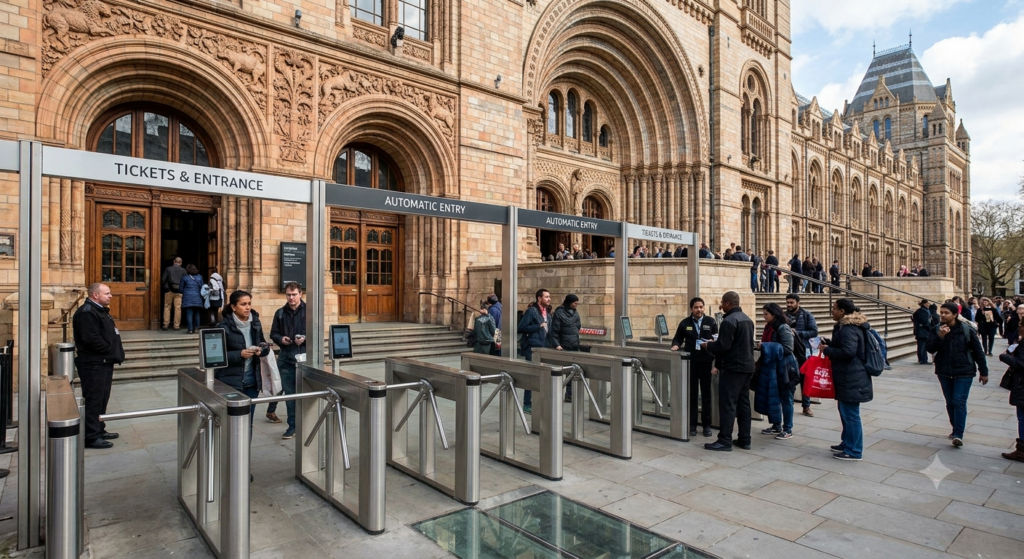
Cultural, artistic, and historical heritage represents one of the fundamental pillars of our society. Museums, art galleries, foundations, archaeological parks, and monumental complexes are not merely custodians of memory, but true catalysts of constant human flows. Managing these structures means balancing two crucial and seemingly opposing needs: guaranteeing maximum accessibility to the public while ensuring the highest standards of security, safety, and preservation for both assets and people.
With the rise in cultural tourism and the need to comply with increasingly stringent safety regulations regarding fire prevention and panic management, access control has ceased to be a mere ticketing formality. Today, the digitalization and automation of entrance gates represent an essential strategic choice.
In this context, latest-generation automated turnstiles emerge as the ideal technological tool to govern the complexity of flows, optimize internal resources, and elevate security and safety levels.
1. The Complexity of Flow Management in Cultural Sites
Public venues that house artworks or historical artifacts present unique logistical challenges, radically different from those of a company, a stadium, or a public transport hub. The very nature of visitors—heterogeneous in age, origin, habits, and motor skills—requires a welcoming approach that is fluid, non-invasive, yet extremely rigorous.
Overcrowding and the “Bottleneck” Effect
On peak days, during internationally renowned temporary exhibitions, or during free-admission Sundays, museums and foundations record attendance spikes that can strain traditional reception systems. Manual ticketing or simple visual ticket inspections by staff inevitably generate long queues outside and crowding in entrance areas (foyers, atriums).
These “bottlenecks” not only deteriorate the visitor experience before the exhibition path even begins, but also create potential safety vulnerabilities, exposing waiting crowds to logistical risks and obstructing escape routes.
Preserving the Microclimate and Heritage
Every museum hall has its own “carrying capacity,” defined not only by floor space but also in relation to specific environmental parameters:
- Relative humidity
- Temperature
- Carbon dioxide ($CO_2$) concentration
The simultaneous presence of a number of visitors exceeding the critical threshold inevitably alters these parameters, accelerating the degradation processes of canvas paintings, frescoes, wooden sculptures, and ancient artifacts. Flow restriction is therefore not just a safety measure for physical safety, but an act of preventive conservation for artistic heritage.
2. What Flow Restriction Is and Why It Is Regulated by Law
Restricting flows means establishing a maximum limit of contemporary presences within a defined space and monitoring in real time that this limit is never exceeded. This principle responds to precise engineering logics and strict national and European regulatory frameworks.
The Regulatory Framework on Safety in Public Places
In Italy, crowd management in public entertainment venues and cultural interest sites is regulated by the Consolidated Law on Public Safety (TULPS), current fire prevention regulations (including the D.M. August 3, 2015, and subsequent amendments), and specific provisions from the Ministry of Culture.
Every structure must have an evacuation plan based on the calculation of maximum foreseeable overcrowding. In an emergency, escape routes and emergency exits must be able to clear the present public within established timeframes. If the number of visitors inside the structure is unknown or higher than the maximum authorized capacity, the effectiveness of the emergency plan fails, exposing directors and managers to severe civil and criminal liabilities.
The Role of Real-Time Monitoring
To ensure compliance with capacity limits, it is not enough to know how many tickets were sold throughout the day. It is essential to have a dynamic, bidirectional data point: how many people entered and how many actually exited at any precise moment. Automated access control systems via turnstiles perform exactly this function, operating a continuous algebraic calculation ($\text{Entries} – \text{Exits} = \text{Current Presences}$).
3. Types of Automated Turnstiles for Authorities and Museums: Choosing the Ideal Solution
Not all turnstiles are created equal. Every architecture and every type of cultural institution requires a specific solution that combines aesthetics, functionality, the required security level, and passage fluidity.
The main technological solutions available on the market are structured in the following classification:
Gate Type | Main Features and Functionality | Ideal Application in Cultural Sites |
Tripod Turnstiles | Compact, robust, and cost-effective. They manage high flows with mechanical or motorized rotating arms. | High-traffic areas, ticket offices with limited space, and secondary entrances. |
Motorized Gates (Speed Gates) | Elegant, featuring rapid-movement tempered glass leaves and anti-tailgating sensors. | Main foyers, modern art museums, and contexts where design is fundamental. |
ABA Motorized Swing Gates | Single leaves with a wide passage clearance ($\ge 900 \text{ mm}$) for removing architectural barriers. | Mandatory access for disabled visitors, visitors with strollers, or transit of goods/equipment. |
Full-Height Turnstiles | Imposing rotating structures (roto-gates) around 2 meters high, providing an insurmountable physical barrier. | Open-air archaeological sites, monumental gardens, and unstaffed outer perimeters. |
3.1. Tripod Turnstiles (Mechanical or Motorized)
They represent the classic and most widespread solution for access control, consisting of an o stainless steel machine body from which three rotating arms originate.
- Operation: The arm blocks passage until the validation system (barcode, RFID, or QR code reader) unlocks the mechanism, allowing manual or motorized rotation for a single user.
- Advantages: High mechanical robustness, reduced footprint, low cost, and great long-term reliability. They are ideal for managing intense flows in tight spaces.
- Safety variants: Models equipped with a spontaneous drop-arm are essential for escape routes: in the event of a power failure or a fire alarm signal, the upper arm drops automatically, leaving the gate completely clear of obstacles.
3.2. Motorized Swing Gates (Speed Gates / Flap Gates)
Motorized gates represent the aesthetic and functional evolution of the tripod turnstile, utilizing tempered glass or transparent polycarbonate leaves that open by rotating or disappearing inside the machine body.
- Operation: Precision infrared sensors detect the approach of a validated user and command the rapid opening of the leaves. The sensors monitor the entire passage to prevent two people from transiting with a single ticket (anti-tailgating).
- Advantages: Elegant, minimalist design with low visual impact, perfect for historical contexts and contemporary art museums where aesthetic impact must be minimized. They offer comfortable passage even for people with luggage, strollers, or wheelchairs.
3.3. Motorized Swing Gates for Disabilities (Regulations on Removing Architectural Barriers)
Museums and public bodies have a moral and legal obligation to guarantee universal accessibility. Alongside standard turnstiles, the installation of at least one motorized gate with a wide passage clearance (usually $\ge 900 \text{ mm}$) is always required.
- Features: These systems feature a single glass flag leaf that opens at 90° or 180°. They can be integrated into the central access control system and activated either via ticket or through a manual command from the reception/ticket office.
3.4. Full-Height Turnstiles (Roto-Gates)
Where perimeter security is the absolute priority, especially for open-air archaeological areas, monumental parks, or secondary entrances unstaffed by personnel, full-height turnstiles offer an insurmountable barrier.
- Structure: Imposing steel structures that cover the entire height of the passage (approx. 2 meters), preventing anyone from climbing over or passing beneath the gate.
4. Technological Integration: Ticketing, Control Software, and IoT
An automated turnstile is not an isolated mechanical island, but the terminal hardware of an integrated digital ecosystem. Its effectiveness depends on its ability to communicate in real time with the authority’s information and security systems, according to the structured logic below:
System Component | Communication Flow and Interaction | Impact on Security and Management |
1. Ticketing (Online or Physical) | Generation and issuance of the access title (QR Code, Barcode, RFID, or EMV contactless). | Guarantees ticket authenticity and prevents the use of cloned copies. |
2. Optical/NFC Reader on Gate | Instant code scanning and transmission of binary data to the central server. | Validates access within fractions of a second, verifying the time slot and current date. |
3. Central Control Software | Processing of the transit, physical unlocking of the turnstile, and algebraic update of presences. | Provides real-time data to control dashboards for staff and management. |
4. Fire Control Unit (Safety) | Priority hardware interconnection via emergency dry contact to the gate boards. | Triggers immediate permanent opening of all gates to facilitate safe egress. |
Integration with Ticketing Systems (Online and Offline)
Modern automated gates mount multi-technology reading heads onboard capable of scanning QR codes and Barcodes printed on paper or displayed on smartphones, RFID / NFC cards (museum passes or staff badges), and EMV systems (contactless credit cards and digital wallets), enabling direct access without passing through the ticket desk. By querying the database in real time, the system checks off the ticket to prevent fraudulent use.
Dialogue with Fire Security Systems (Evacuation)
In the event of an emergency alarm activation, the centralized system sends a priority command that cuts power to the mechanical locks: tripods drop their arms and swing gates open permanently in the direction of egress, ensuring that escape routes are totally unobstructed, in compliance with the EN 13637 standard.
5. The Benefits for Museums, Authorities, and Foundations
The introduction of an access automation system generates a tangible return on investment (ROI) from multiple perspectives: operational, economic, security, and image.
- Optimization of Human Resources and Reduction of Management Costs: Personnel previously tied down to manual ticket checking can be reallocated to higher-value-added activities, such as assistance, orientation within halls, active surveillance of artworks, or the bookshop.
- Fraud Prevention and Revenue Control: The system applies rules rigidly and impartially. It prevents entry with expired or counterfeited tickets, ensuring that every visitor corresponds to regularly registered revenue.
- Data Collection and Business Intelligence for Museum Management: It allows the extraction of detailed reports on hourly, daily, and seasonal attendance curves and average length of stay, enabling scientific and predictive planning of museum activities.
6. Security and Asset Protection: The Value of Passive Security
Beyond logistical aspects, the presence of well-defined physical gates performs an important passive security function. An open entrance devoid of structural barriers can be perceived as vulnerable. Conversely, installing a line of turnstiles sends a clear visual signal: access to this venue is regulated, monitored, and protected.
Turnstiles drastically reduce the possibility of rapid, sudden intrusions (smash and grab actions or demonstrative intrusions by vandals and eco-activists). Because the gate opens for only one person at a time and temporally logs their passage, anyone entering knows they are identified by the system, which acts as a powerful psychological deterrent against improper behavior or acts of vandalism toward the exhibited works.
7. The Visitor Experience: Fluidity and Welcome
A common fear among museum curators and directors of historical foundations is that inserting technological elements and physical barriers might make the environment feel cold or bureaucratic. This risk, however, is eliminated if the installation is designed with anthropocentric and design criteria.
Allowing visitors who bought their tickets online to head directly toward the automated gates, scan their smartphone, and enter independently within a few seconds radically transforms the perception of service quality. Automation eliminates the bureaucratic friction of the transaction, erasing lines and immediately immersing the user into the exhibition path.
8. Design and Installation Criteria in Historical and Listed Contexts
Inserting modern technologies inside historical buildings, period palaces, or protected archaeological sites overseen by Superintendencies requires extreme design sensitivity. Automation must integrate into the architecture without defacing it, respecting the principle of intervention reversibility.
8.1. Non-Invasive and Self-Supporting Installations
In many historic palaces, drilling into ancient floors (precious marbles, historical terracotta, period parquet) to anchor turnstiles is strictly forbidden. Therefore, specific engineering solutions are used:
- Self-supporting platforms: Turnstiles are mounted on special metallic or structural wood bases, designed to distribute weight uniformly and guarantee gate stability without requiring floor anchors.
- Integrated cable routing in platforms: Electrical cables and communication buses run inside conduits carved into the thickness of the platform itself, erasing visual and structural impact on ancient walls.
8.2. Material Choice and Customized Finishes
To harmonize technological devices with historical environments, standard brushed stainless steel can be replaced by customized finishes:
- Corten or bronzed coatings to integrate with classical furnishings or archaeological sites.
- Extra-clear glass leaves with high transparency to minimize visual impact and preserve the perspective lines of historical corridors.
- Inserts of noble materials (wood, local stone) on the turnstile machine body.
9. Preventive Maintenance, Life Cycle, and Sustainability of Automated Gates
An automated access control system is a long-term investment. Since these machines are subjected to an intensive workload, component quality and maintenance planning are decisive factors in ensuring the museum’s operational continuity.
Quality Mechanical and Electronic Components
The robustness of a turnstile is measured by the quality of its internal components:
- Native technology brushless motors: They offer very high energy efficiency, require no brushes (reducing mechanical wear to zero), are silent, and guarantee millions of cycles without needing extraordinary interventions.
- Slowing systems and electronic clutches: They prevent violent impacts of the leaves, ensuring user safety and extending the useful life of motors and gears.
10. Summary for Decision Makers: Comparative Summary Table
To support Foundation Boards of Directors, Museum Directors, and Public Authority Technical Managers, the following table summarizes the choice criteria for purchasing and positioning gates:
Gate Model | Physical Security Level | Transit Fluidity | Aesthetic Impact / Design | Suitability for Escape Routes (Safety) | Ideal Context of Use |
Tripod Turnstile | Medium | High | Fair | Excellent (with drop-arm) | High-attendance museums, secondary entrances, compact ticket offices. |
Swing Gate (Speed Gate) | High | Excellent | Great / Elegant | Excellent (automatic opening in emergency) | Foyers of large museums, art foundations, prestigious entrances. |
ABA Motorized Gate | Low (single gate) | Medium | Very refined | Excellent (permanent 90° opening) | Mandatory complementary gate for disabilities, strollers, and goods. |
Full-Height Turnstile | Maximum | Medium-Low | Large footprint | Requires adjacent dedicated escape gate | Open-air archaeological parks, unstaffed monumental gardens. |
Conclusions: Automation as an Ally of Culture
Implementing turnstiles and automated gates in museums, foundations, and historical institutions represents the enabling factor for a modern, secure, welcoming, and sustainable management of cultural heritage.
Relying on evolved technological solutions allows for protecting artworks from human wear, guaranteeing visitor safety in an emergency, eliminating economic and operational inefficiencies, and giving internal staff back the time needed to dedicate themselves to guest care and knowledge enhancement. In a world where cultural tourism is constantly expanding, access automation is the cornerstone for transforming places of memory into smart spaces, ready to welcome the future in total safety.