



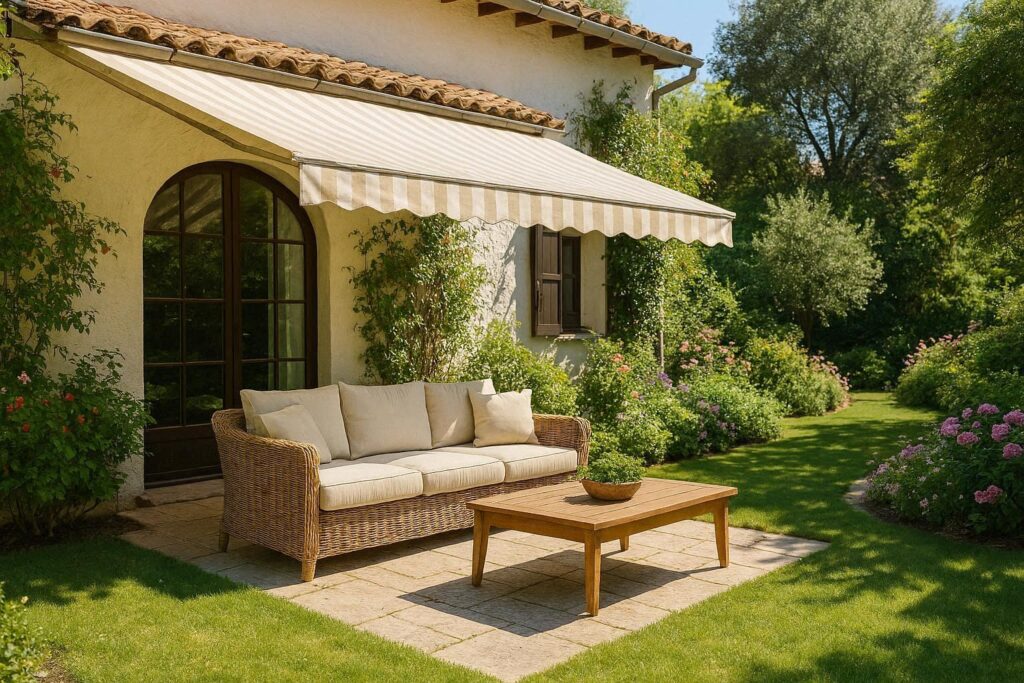
The arrival of the warmest months brings a desire to rediscover the outdoor areas of the home. The garden, patio, veranda, or terrace are transformed into true extensions of the living zone—ideal spaces for relaxing, entertaining friends, or enjoying a quiet moment. However, direct solar radiation and rising temperatures can render these areas unusable, turning moments of relaxation into situations of intense discomfort.
Managing light and temperature intelligently is not only essential for well-being but also a decisive factor in the energy efficiency of the entire home. To achieve maximum livability with zero effort, modern technology offers advanced solutions capable of radically transforming the daily management of fixtures and solar shading. Adjusting the shade on your patio or protecting interior rooms from oppressive heat becomes an immediate, fluid, and entirely automated operation.
Designing Outdoor Well-Being: Patio, Veranda, and Garden
Enjoying the open spaces of your home to the fullest requires careful planning of shaded areas. Without proper shading, solar rays strike paved surfaces and building walls directly, accumulating heat that then propagates inside the rooms. Installing structures such as sun awnings, pergolas, or veranda covers represents the first step in curbing this phenomenon.
However, a traditional manual awning requires continuous human intervention. The physical action of opening and closing it using a classic crank handle can be tiring—especially with large coverings—and often discourages use of the awning itself. Conversely, integrating a motorized system inside the winding roller completely changes the user experience.
The Benefits of Automation for Solar Shading
- Effort Management: Eliminating manual operation allows anyone, including the elderly or those with reduced mobility, to operate heavy coverings or those placed in elevated positions.
- Movement Precision: Electric motors guarantee constant, linear traction on the fabric, reducing mechanical stress and premature wear on seams and extensible arms.
- Architectural Integration: Tubular motorization systems are inserted directly inside the winding shaft, preserving the aesthetics of the structure without adding bulky visible elements.
- Passive Energy Savings: Timely shading of glass surfaces and adjacent areas before they overheat reduces the need for air conditioning systems, cutting electricity consumption.
Via a simple wall switch or remote control, you can set the exact level of shading desired. This level of control allows you to create an ideal microclimate on the patio or in the garden, keeping the environment cool and ventilated even during the central hours of the day.
VDS Automations Technology at the Service of the Home
To guarantee high performance, silence, and durability over time, it is essential to rely on components of specialized design and production. VDS Automations designs solutions dedicated to the movement and security of every type of entrance or closure: from automations for sliding or swing gates to traffic barriers, bollards, sectional and up-and-over garage door systems, as well as motors for fixtures such as skylights, domes, windows, and roller shutters.
In the specific field of solar protection and residential shading management, the VDS range of tubular motors stands out for its mechanical reliability and its ability to adapt to different weights and dimensions. The flagship models for this sector are the KINDI and KENDA motors, designed to offer maximum control over roller shutters and sun awnings.
VDS TUBULAR MOTOR RANGE | |
Feature | Technical Detail |
Main Structure | Painted die-cast aluminum |
Limit Switch | Millimetric manual adjustment |
Power Supply | 230 Vac |
Warranty Coverage | 5-year extended warranty |
KINDI: Efficiency and Integrated Thermal Protection
The KINDI tubular motor represents the ideal choice for motorizing electric roller shutters and shading systems with weights ranging from 36 kg to 350 kg. Built with a painted die-cast aluminum body, this gearmotor combines a compact design with remarkable resistance to mechanical stress.
The distinctive feature of the KINDI model is its advanced safety system against thermal anomalies:
- Protection Device: If the motor is operated repeatedly or remains active beyond standard operating times, the internal temperature rises. The integrated sensor detects the anomaly and activates an automatic shutdown to prevent structural damage.
- Automatic Reset: Once the internal temperature falls back within safety parameters, the system reactivates autonomously, making the motor ready for use again without requiring manual release interventions.
This protection mechanism is vital during the summer, when high ambient temperatures inside shutter boxes or near outdoor coverings accelerate the overheating of electrical components.
KENDA: Robustness and Manual Override for Maximum Safety
The KENDA model is a tubular automation specifically developed to handle heavy loads, suitable for both heavy roller shutters and large-scale sun awnings, covering weights from 90 kg up to 350 kg (available in torque variants from 50 Nm to 300 Nm).
In addition to sharing a robust die-cast aluminum structure and a precision mechanical limit switch, the KENDA motor introduces an essential safety element for outdoor installations: the manual override (emergency maneuver).
Technical Note on the Manual Override: The manual override allows the awning or roller shutter to be operated mechanically via a manual crank handle even during a total power outage. This system prevents the risk of the covering getting stuck in an open position during a sudden blackout or summer storm, allowing the fabric to be secured to avoid tears caused by strong winds.
Both KINDI and KENDA come equipped with a wide selection of brackets and adapters (for standard 60 mm and 92 mm octagonal tubes), ensuring maximum compatibility with most pre-existing structures on the market. The reliability of these products is backed by an extended warranty of up to 5 years offered by VDS Automations.
The Professional Installation Process: How the Specialist Works
Choosing a high-performance motor is only the first step in ensuring the proper functioning of an automation system. Installation requires specific technical skills regarding weight balancing, safe electrical connection, and limit switch calibration. A specialized installer follows a rigorous protocol to transform a manual shutter or awning into a smart system.
- Preliminary Inspection and Context Study
Before moving any component, the technician carries out a thorough visual and structural inspection.
- Checking Existing Mechanics: In the case of sun awnings, they check the alignment of the arms, the condition of the winding roller, and the stability of the wall or ceiling anchoring brackets. For roller shutters, the integrity of the side guides and the absence of critical friction are examined.
- Weight and Torque Calculation: The installer calculates the actual weight of the structure based on the surface area and the type of material (heavy acrylic fabric, PVC, insulated aluminum, or steel). This data determines the choice of nominal torque expressed in Newton-meters ($Nm$). An incorrect calculation would lead to excessive motor strain or, conversely, a waste of energy.
- Shutter Box or Roller Accessibility: The space available for housing the side brackets and routing the power cables to the home grid is verified.
- Preparation, Assembly, and Motor Insertion
Once the parameters have been established and the appropriate motor chosen (such as KINDI or KENDA depending on the configuration), the technician proceeds to the operational assembly phase.
MOTOR SHAFT ASSEMBLY PHASES |
1. Dismantling of the manual winding roller |
2. Removal of pulleys, caps, and old cord or winch systems |
3. Selection of the correct adapter and crown matching the tube profile |
4. Insertion of the tubular motor inside the galvanized tube |
5. Securing the motor head to the rigid side bracket |
The use of a fixed, rigid bracket is fundamental: it guarantees motor stability, absorbs vibrations during startup, and stops the counter-rotation of the casing, ensuring extremely silent operation inside the home.
- Electrical Connection and Safety Wiring
VDS tubular motors operate at a standard voltage of 230 Vac. The installer performs the wiring in compliance with current electrical regulations, bringing the power line into the junction box.
- Switch Configuration: A local interlocked switch (up/down) is connected, which prevents the simultaneous sending of both commands, preserving the integrity of the internal circuits.
- Radio/Smart Configuration: If radio control units are present, the technician pairs them with handheld remote controls or smart home modules for remote control via smartphone.
- Millimetric Adjustment of Limit Switches
Calibrating the stop points is the most delicate operation of the entire process. Mechanical adjustment screws are located on the motor head to define the maximum number of rotations the shaft can make during opening and closing.
- Up Limit Switch: The technician adjusts the upper stop point so that the awning tensions perfectly without straining the mechanical arms, or so that the roller shutter stops precisely before the stopper plugs hit the shutter box.
- Down Limit Switch: The lower limit is set to prevent the awning fabric from rolling up in reverse or to ensure that the roller shutter attachment straps do not deform due to excessive downward push on the terminal slat.
- Testing and Continuous Operation Checks
Once installation is complete, the specialist performs a series of systematic tests, running the automation through at least 5-6 complete up and down cycles. This serves to:
- Verify the linearity of the movement and the absence of abnormal noises or jerks.
- Check the alignment of the fabric along the roller, preventing side creases that would damage the material over time.
- Ensure that thermal protection systems or manual overrides (in the case of the KENDA model) are fully operational and accessible to the end user.
Why Automation Improves Energy Efficiency
The impact of an automated shading system goes far beyond simple user comfort. In the context of modern, energy-conscious building design, dynamic management of openings is a fundamental pillar for indoor temperature control.
When solar rays strike a glass surface lacking protection, a greenhouse effect occurs: solar radiation penetrates the rooms, is absorbed by furniture and walls, and transforms into heat that cannot escape. Lowering the roller shutters or extending outdoor sun awnings interrupts this cycle before the radiation reaches the glass.
DYNAMICS OF THERMAL CONTROL | |
Phase 1: Radiation | Direct solar rays strike the building. |
Phase 2: Active Shading | The motorized awning or shutter lowers promptly. |
Phase 3: Reflection | Heat is repelled outside the glass surface. |
Final Result | The indoor environment remains cool, reducing air conditioner use. |
By automating this process, the action becomes consistent and effective. By preventing heat accumulation during the morning hours, interior rooms stay naturally cool. Consequently, the workload of air conditioning units is significantly reduced, translating into immediate financial savings on energy bills and a lower environmental footprint for the home.
Preventing Summer Heat: The Importance of Timely Intervention
The most common mistake in home maintenance management is waiting for the heatwave to arrive before requesting a professional intervention. As the summer season approaches, installation and maintenance requests experience an exponential increase, saturating the availability of specialized technicians.
Planning the installation of motors for sun awnings and roller shutters well in advance offers significant strategic advantages:
- Service Continuity and Avoiding Summer Shutdowns: Around the month of August, most manufacturers and component distributors close for summer holidays. Delaying your request for intervention carries a concrete risk of not having the necessary spare parts or motors available, forcing you to spend the hottest weeks of the year without adequate solar protection.
- Accurate Structure Analysis: A scheduled intervention allows the technician to work without emergency urgency, performing a thorough check of the fixture stability and ensuring millimetric calibration of components.
- Readiness for Use: Completing the installation before thermal peaks occur allows you to exploit the benefits of VDS motors right from the first heat, protecting the home preventively and avoiding the overheating of interior walls.
Securing the support of a qualified installer before summer allows you to transform your patio, veranda, and interiors into cool, protected, and comfortable spaces, ready to offer maximum well-being throughout the hot season.