



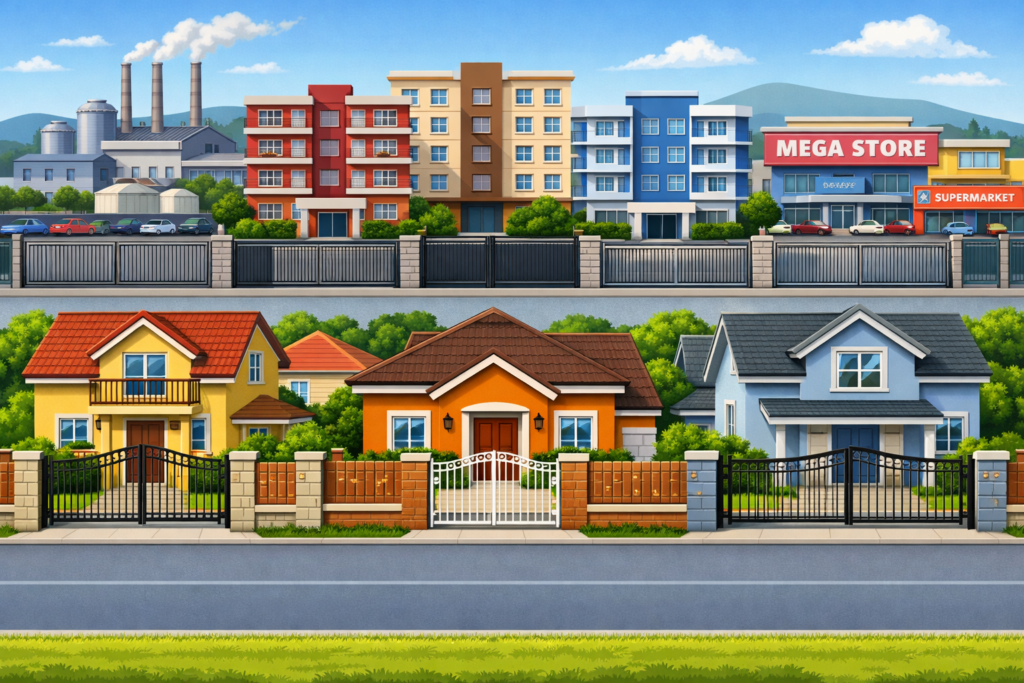
Deciding to automate a gate is not a trivial choice. Whether it’s a single-family home, a condominium, or an area with heavy vehicle traffic, each context has specific needs that require different solutions. Choosing the right motorization system ensures safety, comfort, durability, and a sound economic investment. This practical guide will help you navigate the available options, regardless of your situation.
Usage Scenarios: From Residential to Intensive
The choice of automatic gate starts with a fundamental question: how many times a day does the gate open and close? This usage frequency determines most of the required technical specifications.
Residential Context
In a private home, the gate opens on average a few times a day—when returning from work, leaving, or occasionally for guest visits. We’re talking about 5-10 openings per day on average. In this scenario, a lightweight electromechanical motorization is more than sufficient. The emphasis is on comfort: avoiding getting out of the car to open the gate manually, especially in bad weather. Costs are contained, and reliability is guaranteed for many years with minimal maintenance.
Condomonial Context
When a gate serves a condominium with 10-20 housing units, the dynamics change completely. If each unit generates an average of 4 openings per day, we reach 40-80 daily openings. This frequency adds variability: different people use it at different times, with higher stress on the mechanism. In these cases, hydraulic motorization becomes preferable. Hydraulic systems offer greater robustness, high long-term reliability, and more balanced load distribution even over the years.
Intensive Use
Public parking lots, company facilities, shopping centers. In these contexts, we’re talking about hundreds of openings and closures per day. The gate operates almost continuously during operating hours. Only robust systems designed for frequent cycles ensure reliability. This aspect is non-negotiable: power, resistance, and a design for extreme use are required.
Swing vs. Sliding Gates: Choosing the Right Type
Beyond the usage context, the physical type of gate deeply influences the automation choice. The two main paradigms are swing and sliding.
Swing Gates
These are traditional ones, with one or two leaves rotating on a central hinge. They require lateral space for opening (at least the gate’s width on each side). The weight per leaf is generally lower than that of sliding gates, as the length is limited to about 2.5-3 meters per leaf. The mechanism is a first-class lever: simpler, less expensive, easier to maintain. They are the ideal choice for private homes and condominiums where sufficient installation space is available.
Sliding Gates
They slide laterally on a track, transferring weight to wheels. They take up less lateral space (only the gate’s depth at most), but require space for the leaf to slide. Leaves can be very long (up to 6-8 meters and beyond) and heavy (up to 5000 kg in industrial systems). The mechanism is more complex but allows wide openings ideal for companies with large vehicles. They cost more both for the gate itself and the motorization, but when lateral space is unavailable, they are the only solution.
Hydraulic vs. Electromechanical Motorization: Functional and Economic Comparison
The choice of thrust technology—hydraulic or electromechanical—is another critical factor.
Electromechanical Systems
They use an electric motor, speed reducer, and linear actuator or motorized arm. They are compact, quiet, efficient (they only consume during opening and closing). They install easily in residential contexts and require no special maintenance beyond periodic lubrication. The initial cost is lower. They are ideal for light gates (up to 1500 kg in standard variants) and environments where quiet operation is appreciated. In recent years, electromechanical technology has made huge progress in robustness and reliability, gaining acceptance even in condominiial contexts.
Hydraulic Systems
They exploit fluid pressure (oil) to generate the necessary force. They are extremely robust, capable of supporting very frequent cycles and very heavy loads (up to 5000 kg and beyond). They distribute the load more evenly on the gate structure. More frequent maintenance is required: hydraulic fluid must be checked and possibly replaced, and their inherent robustness needs more installation space. Initial and maintenance costs are higher. They are the obligatory choice for long gates (over 4 meters) and very high-frequency contexts.
In summary: if your gate weighs less than 1500 kg, opens less than 100 times a day, and you have limited space, electromechanical is the winning choice. If you exceed these parameters, hydraulic is the right investment.
Specific Advantages for Each Context
Residential Area
In a home, an automatic gate solves many daily inconveniences. No more getting out in the rain or heat to open it manually. In winter, when the gate is frozen, the motor still does its job. The psychological comfort is enormous: a property with an automatic gate feels more modern, safer, more convenient. This also reflects in the property value—a real estate study will tell you that a home with automatic gate and integrated video surveillance attracts many more buyers during sales.
Safety is a non-negligible plus. An automatically closing gate discourages curious people and occasional intruders. Integrated with a camera or video intercom, it creates a first level of control, making a difference in access management.
Condomonial Area
In a condominium, advantages multiply. Access management becomes mechanical—no one forgets to close the gate. With an automatic intercom, the gate opens only for authorized people. Community security increases, thefts are discouraged.
On maintenance, a robust system (hydraulic or high-end electromechanical) greatly reduces disruptions. A breakdown means more hassle for 20 families, not just one. Condominiums tend to invest more in reliable systems, knowing downtime costs are high.
Moreover, image matters in a condominium. A well-maintained automatic gate conveys seriousness, order, and attention to detail—factors influencing community sense and even real estate values.
Commercial and Parking Areas
In a company, parking lot, or shopping center, the automatic gate is essential. It solves traffic flow management: cars don’t queue at the gate, traffic flows smoothly.
Economically, management cost savings are significant: no full-time custodian needed. The system is remotely controlled, integrated with access systems (badges, plates, codes), and provides a trace for every access. This is crucial for company asset security, paid parking control, theft prevention.
Finally, maneuver speed is essential. A gate taking 30 seconds to open is an unacceptable bottleneck. Fast-opening sliding gates solve it, and the cost of more powerful motorization is easily amortized by operational efficiency gains.
Preventive Maintenance: Not a Cost, but an Investment
Regardless of context, preventive maintenance is key to avoiding costly surprises. One or two annual checks—lubricating mechanisms, visually inspecting components, verifying alignment—extend system life by 5-10 years.
In residential areas, maintenance is minimal. In condominiial, formalize it in regulations and assign to a qualified technician. In commercial, scheduled maintenance must be part of the service contract, with guaranteed quick interventions.
A well-maintained motorization not only lasts longer but operates quietly, safely, and reliably. It’s an economic convenience, not a luxury.
Practical Checklist: How to Evaluate and Decide
Before contacting an installer, answer these questions:
- Usage Frequency: How many average daily openings? (Residential: 5-15; Condominiial: 30-100; Commercial: 100+)
- Gate Type: Swing or sliding? If swing, how wide and what weight? If sliding, total length and weight?
- Available Spaces: Do you have lateral space for swing? If not, sliding is mandatory.
- Budget: What’s your spending range? Residential system: 800-2000 euros; Condominiial: 2000-5000 euros; Commercial: over 10,000 euros.
- Security Needs: Want video surveillance, intercom, remote control integration? These affect control electronics.
- Climate and Environment: Exposed to sun, rain, strong wind? Coastal areas with salt require different materials and finishes.
- Maintenance: Available for annual checks, or prefer “set and forget”?
Armed with this info, a qualified professional can advise the ideal solution for your context.
VDS Automazioni Solutions: Made in Italy Quality for Every Need
For over thirty years, VDS Automazioni has produced gate motorizations with the quality and reliability that distinguish Italian engineering. The company perfectly understands that every context has different needs: that’s why it has developed a complete range from simple residential systems to robust commercial solutions.
For sliding gates, the VDS line offers motors of varying power. SIMPLY is ideal for light gates up to 600 kg, perfect for residential and small condominiums. CARRERA supports up to 1500 kg, covering most medium-sized condominiial and commercial scenarios. For even more demanding applications, ATPLUS reaches 2500 kg, ensuring reliable performance even in high-frequency contexts.
For swing gates, VDS offers an equally complete series. The LINEAR actuator is a versatile and robust solution for gates up to 3 meters. EGO is the compact arm actuator, ideal where space is limited. For more sophisticated applications requiring burial, UNDER-V is the elegant and discreet choice. Finally, IBIS, the articulated actuator, offers installation versatility and proven long-term reliability, configurable at 24V for greater safety.
All these products were developed in-house by VDS, from design to production, with rigorous testing for reliability and longevity. VDS’s proximity—both geographical and communicative—to its customers, installers, and dealers means technical support and spare parts availability are guaranteed over time. Choosing a VDS motorization means investing not just in a product, but in an ongoing assistance and trust relationship beyond initial installation.
Whether automating a villa, coordinating a condominium access system, or managing company parking efficiency, VDS Automazioni has the right technical solution and technicians to advise you. Contact a qualified installer or visit VDS directly to discover the configuration for you.