



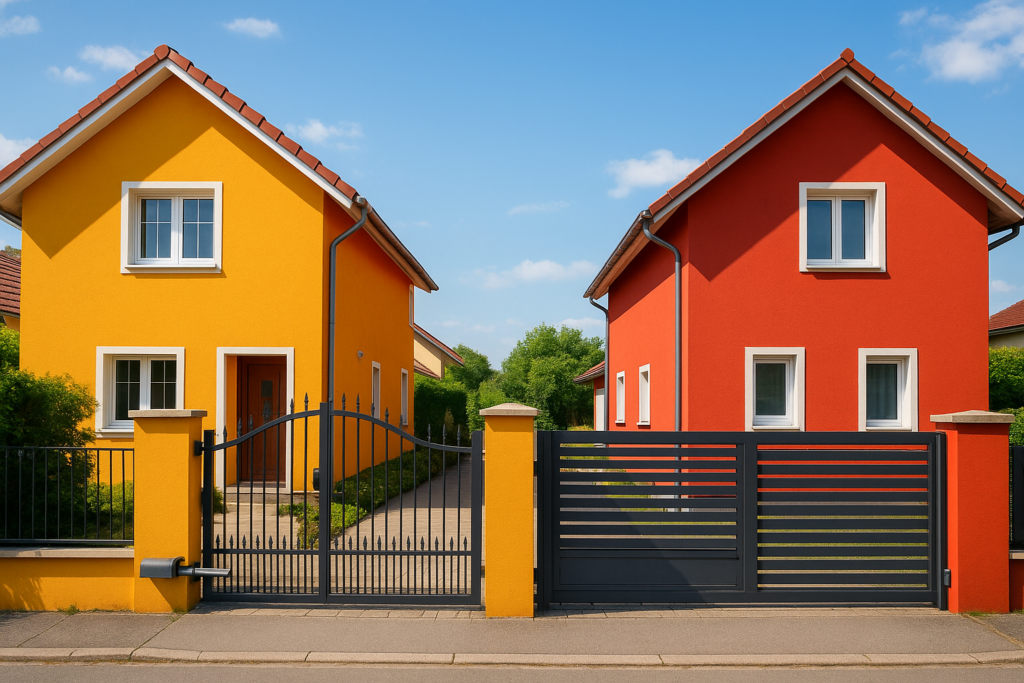
Choosing the right automation for your gate is a fundamental decision that directly impacts practicality, safety, and longevity of the device. Whether you’re a homeowner wanting to automate your entrance or a professional installer tasked with recommending the best solution, understanding the different types of gates and their specific needs is the first step toward an informed choice.
This guide explores how to identify the type of gate on your property, analyzes the technical features that determine compatibility with automation systems, and reveals solutions offering the best balance of performance, safety, and reliability. It also covers specific aspects for industry professionals to provide your clients with the best possible recommendations.
Identifying Your Gate Type
The first essential step in selecting the correct automation is accurately identifying your gate type. There are mainly two categories: swing gates and sliding gates. Though they seem simple, they have very different structural characteristics that directly influence automation choice.
Swing Gates
Swing gates are the most traditional and common solution. They consist of one or two leaves that open inward or outward from the property. For two leaves, it’s commonly called a “double swing gate,” where each leaf moves independently for symmetric opening.
The main feature is vertical clearance: the gate needs empty space in front or behind to fully open. This space requirement significantly affects automation choices. Swing gates are often made from heavy materials like wrought iron, galvanized steel, or metal alloys for structure, strength, and durability.
To recognize a swing gate, check the closing mechanism: if it opens via vertical hinges on one or both sides, it’s a swing gate.
Sliding Gates
Sliding gates are a modern, practical solution for limited spaces. Unlike swing gates, they move laterally along a track or guide structure, without needing space in front or behind. This makes them ideal for narrow entrances or space optimization.
There are two variants: track sliding gates, which run on a ground-fixed track, and cantilever sliding gates, which stay a few centimeters off the ground via their own support structure during movement.
To identify a sliding gate, look for a horizontal track (usually steel or aluminum) fixed to the ground in front, or observe if it moves sideways without fixed supports.
Key Technical Parameters for Automation Selection
Once the gate type has been identified, it is necessary to evaluate a series of technical parameters that determine compatibility with available automation systems. These parameters are not purely theoretical but have concrete implications for the safety, efficiency, and lifespan of the automation itself.
Gate Wing or Structure Weight
The most critical parameter in choosing automation is the total weight of the gate or individual wing (in the case of double-leaf gates). Each automation is sized to support a specific maximum weight, generally expressed in kilograms. Using an undersized automation relative to the gate’s actual weight poses serious risks: the motor will be under continuous stress, consume more energy, have a reduced lifespan, and may even stall, leaving the gate in an intermediate position.
To measure the gate’s weight, the most accurate method is to lift it manually (if possible with help) and use a scale or portable load cell. For very heavy gates, consult the original design documentation if available, or contact industry professionals.
Weight varies significantly based on material: a wrought iron gate can easily reach 150-300 kg per wing, while an aluminum gate will be considerably lighter, between 30-80 kg.
Gate Dimensions
Dimensions affect both weight and the mechanical forces involved during opening and closing. A very wide gate will generate a greater lever arm than a narrow one, requiring a more powerful motor. Similarly, a very tall gate will increase the total weight.
Measure the total height and width of the gate for a complete picture of its dimensions. For sliding gates, also check the track length and available space for full opening.
Usage Type: Residential, Condominial, Industrial
Automation must be selected not only based on the gate’s physical characteristics but also on the expected frequency and intensity of use. A residential automation, intended for a few daily operations in a single home, has very different technical specifications from a condominial one used dozens of times daily, or an industrial one subjected to continuous cycles.
Each usage class requires motors with different characteristics in terms of power, heat dissipation, and construction materials.
Structure Condition
The sturdiness of the gate structure and hinges (for swing gates) or track and supports (for sliding gates) is decisive. If the structure is damaged, worn, or not perfectly aligned, the automation may not function correctly, regardless of the motor’s power. Before proceeding with automation, it is essential to verify that the gate is in good structural condition and that all mechanical movements are smooth and free of abnormal friction.
VDS Automazioni: Italian Excellence in Gate Motorization
For over thirty years, VDS Automazioni has represented excellence in the sector of automatic access motorization in Italy. The company, headquartered in Italy, produces superior quality automations for swing gates, sliding gates, barriers, automatic doors, sectional doors, and shutters, combining reliable engineering with continuous innovation.
VDS Automazioni has built its reputation on key pillars: the quality of raw materials used, constant research and development, and dedicated professional support for installers and dealers. With a base of over 10,000 satisfied customers and a network of 80 specialized partners, the company has demonstrated its ability to provide reliable and long-lasting solutions.
VDS Range for Swing Gates
For swing gates, VDS Automazioni offers a complete range of automations designed to deliver high performance and ease of installation. VDS solutions for swing gates are designed to work on both light and heavy gates, ensuring maximum flexibility for residential, condominial, and commercial installations.
VDS swing gate automations stand out for their robust construction, energy efficiency, and precise management of opening and closing cycles. The integrated control board allows customized programming, while built-in safety systems fully comply with current regulations on automatic access safety.
Light Swing Gates (up to 80-100 kg)
If your swing gate is made of aluminum, untreated wood, or lightweight composite materials, it falls into this category. For this class of devices, moderately powered automations are available, usually powered by 230V single-phase. These solutions take up little space, consume relatively little energy, and are easy to install, such as the Electromechanical Actuator IBIS.
Medium Swing Gates (81-150 kg)
Galvanized steel or light iron gates fall into this category. They require medium-power automations, with 230V or low-voltage (24V) motors. Solutions like EGO or linear ones like LINEAR 11 may suit you. These automations offer a balance between power and consumption, suitable for both residential and light condominial use.
Heavy Swing Gates (over 150 kg)
Massive wrought iron, copper, or heavy steel gates require robust and powerful automations, often with sturdy motors or high-power low-voltage technology. These solutions are designed to withstand intensive use cycles and are suitable for condominial and commercial contexts. VDS offers a wide range of solutions for this case, surface-mounted like the Hydraulic Actuators PH or buried actuators like UNDER-V.
VDS Range for Sliding Gates
In the sliding gates segment, VDS Automazioni offers sophisticated and reliable solutions. The VDS Simply kit, for example, is specifically designed to facilitate the installation and use of sliding gates in residential and commercial environments, with a robust and functional design that ensures safety and practicality in access.
VDS sliding gate automations are characterized by smooth and quiet movements, an essential aspect especially in residential contexts where noise is a disturbance factor. The technology used ensures smooth openings and closings, while reducing energy consumption and extending the system’s lifespan.
Light Sliding Gates (up to 200 kg)
Sliding gates made of aluminum with modern structures require dedicated automations, with gearmotors specifically designed for sliding movement. Solutions for this category, like GEKO from VDS Automazioni, prioritize movement fluidity and quietness.
Medium Sliding Gates (201-500 kg)
This category includes steel sliding gates or larger aluminum ones. They require gearmotors with increased robustness, often with integrated thermal protections and advanced control systems. VDS offers numerous solutions in this field, with a wide range of gearmotors, including versions with ESPRESSO motors, which with their adjustable 8-20 m/min speed make access faster, optimizing the flow of people and vehicles.
Heavy Sliding Gates (over 500 kg)
Large commercial or industrial sliding gates require oil-bath gearmotors of high power and durability. These systems, like the TOM Gearmotor, are designed for fast openings and continuous cycles.
Guide for Installers: How to Advise and Select the Correct Automation
For industry professionals, technical consulting is a crucial aspect of their service. An experienced installer does not just mount a motor but acts as a technical consultant, guiding the client toward the optimal solution based on their specific situation.
Accurate On-Site Survey Phase
The on-site survey is the foundation of proper consulting. During this phase, it is essential to gather all relevant information:
First, document the gate structure photographically from multiple angles, highlighting any structural defects, wear, or elements that could affect automation installation. Measure the gate’s actual weight using professional techniques: if the gate is removable, use a scale or load cell; if fixed, perform calculations based on materials and dimensions, or consult the original documentation.
Check the condition of all mechanical components: hinges for swing gates, tracks and sliders for sliding gates. A gate with worn hinges or misaligned tracks will not work correctly even with the best automation available.
Identify physical obstacles: during opening and closing, does the gate interfere with objects, plants, cars, or surrounding infrastructure? This information is essential to determine the feasibility of the automatic solution and prevent future issues.
Gather information on the expected usage frequency from the client: is it access to a single home (residential), a condo with dozens of units (condominial), or a commercial structure with heavy traffic?
Specialized Technical Consulting
Based on the collected information, provide the client with clear and transparent consulting. Avoid overly technical language, but explain in understandable terms why you are recommending a specific solution.
For example, you can phrase your advice like this: “Your gate weighs approximately 120 kg and will be used a few times a day. The most appropriate solution is a residential-class automation, powered by 230V single-phase. This choice ensures reliability, low energy consumption, and ease of maintenance. If you will use the gate dozens of times daily, I recommend considering a condominial-class solution, which has higher thermal capacity and longer lifespan cycles.”
Compatibility Assessment
As a professional, you must evaluate whether the gate is actually suitable for automation or requires preliminary structural adjustments. For example:
- · If the hinges of a swing gate are worn, advise replacing them before installing the automation.
- · If the track of a sliding gate is misaligned, alignment must be performed before motorized installation.
- · If the structure shows significant cracks or deformations, advise a survey by a restorer or structural technician.
Choice Among Different Technology Types
The market offers different automation technologies: hydraulic (oil-bath motors), electromechanical (electric motors with reducer), and newer technologies like brushless low-voltage systems.
Each technology has specific characteristics:
- · Hydraulic solutions: robust, durable, ideal for intensive cycles, but require periodic maintenance.
- · Standard electromechanical solutions: balance between performance and costs, suitable for most residential applications.
- · Brushless and low-voltage solutions: energy-efficient, quiet, with advanced digital controls, but potentially more expensive.
Recommend the most appropriate technology for the client’s usage profile.
Transparent Communication of Costs and Timelines
Provide realistic and transparent estimates. Communicate clearly:
- · The total cost of the intervention, including the motor, installation, any safety accessories, and final testing.
- · Expected installation timelines.
- · Any preliminary structural adjustment phases for the gate.
- · Future maintenance methods and costs.
- · Applied warranties and post-installation support conditions.
Environmental and Regulatory Factors to Consider
Beyond pure technical parameters, there are environmental and regulatory factors that influence automation choice.
Climatic and Environmental Conditions
If the gate is exposed to harsh environmental conditions (coastal saline climate, extreme temperatures, high humidity), select automations with specific materials and coatings that resist corrosion and accelerated wear.
Safety Regulations
Automations for accesses must comply with current safety regulations, including European standards on injury prevention. The automation must be equipped with emergency systems, photocells, emergency buttons, and, in public or semi-public contexts, light and sound signals.
Permits and Urban Planning Constraints
Always check with the local administration if the gate opening outward conflicts with public space or surrounding infrastructure. In some cases, a sliding solution may be necessary instead of swing, due to regulatory issues.
Conclusions: The Conscious Choice
Choosing the right automation for your gate is not a trivial decision but the result of a careful evaluation of multiple technical, regulatory, and environmental factors. Correctly identifying the gate type, measuring critical parameters like weight and dimensions, and assessing the usage profile are the foundations for building competent consulting and a long-lasting solution.
For end customers, this knowledge translates into greater awareness in choice and the certainty that the investment will bring concrete benefits in terms of safety, convenience, and long-term reliability.
For industry professionals, these elements represent the body of expertise that distinguishes an amateur installer from a true technical consultant. Companies like VDS Automazioni, with three decades of experience and a complete range of solutions, provide reliable products, specialized technical support, and training programs to ensure every installation meets the highest standards.
Investing in continuous training, staying updated on new technologies, and maintaining professional relationships with leading sector manufacturers like VDS Automazioni are the keys to offering clients truly adequate solutions for their specific needs.
Whether you are a homeowner seeking automation for your access or a professional tasked with advising the best solution, remember that the right choice today is the foundation of tomorrow’s safety, comfort, and reliability.